Introduction
Buying an electric vehicle is just the beginning — getting a reliable home charger installed is the next big decision, and for many Des Moines homeowners, the cost is the biggest unknown. Unlike predictable purchases, EV charger installation pricing isn't one-size-fits-all. A simple setup in a newer home might cost under $1,000, while older homes requiring electrical upgrades can easily push the total past $5,000.
This guide covers everything you need to budget accurately and avoid surprises:
- Pricing tiers and what each level typically includes
- The key factors that drive installation costs up or down
- What a professional quote should cover
- Federal incentives and other ways to reduce your total cost
- Common mistakes that turn affordable installs into expensive ones
Key Takeaways
- Level 2 EV charger installations in Des Moines typically run $1,000–$3,000+ all-in (charger, labor, materials, permit)
- Distance from your electrical panel and whether your panel needs an upgrade are the two biggest cost drivers
- Older homes often require panel work first, which adds $500–$4,000 to your total
- The federal 30C tax credit covers 30% of installation costs up to $1,000, but expires June 30, 2026
- Getting multiple quotes from licensed electricians with EV installation experience helps you avoid overpaying
How Much Does EV Charger Installation Cost?
EV charger installation costs vary widely based on your home's electrical setup, charger type, and how far the wiring needs to run. Getting the right estimate upfront saves you from budget surprises mid-project.
Nationally, installation costs (excluding equipment) average around $2,442, according to 2025 data from Qmerit and EnergySage. Iowa-specific installation labor averages slightly lower at $2,246, a useful starting point for Des Moines homeowners planning their budget.
The three tiers below show how those numbers break down in practice — and which scenario most likely applies to your home.
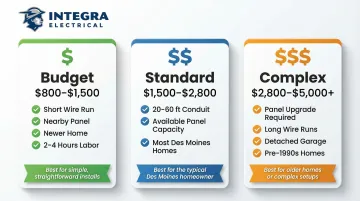
Budget-Friendly Installation: $800–$1,500
What's typically included:
- Level 2 charger unit ($300–$600)
- Short wire run from a nearby panel (5–20 feet)
- New 240V dedicated circuit and breaker
- Permit fee
- 2–4 hours of licensed electrician labor
Best for: Newer homes with a 200-amp panel, garage adjacent to the electrical panel, and no existing capacity issues. Minimal materials and labor needed.
Standard Installation: $1,500–$2,800
What's typically included:
- Level 2 charger unit
- 20–60 feet of conduit and wiring
- Circuit breaker installation
- Permit and inspection fees
- Labor for a more complex route through walls or across the garage
Best for: Homes where the panel has available capacity but the charger location requires a longer wire run or some wall fishing. Most Des Moines homes with updated 200-amp service fall into this range.
Complex Installation: $2,800–$5,000+
What's typically included:
- Everything in a standard install, plus one or more of:
- Electrical panel upgrade (100A to 200A)
- Subpanel addition
- Long wire runs (60–80+ feet)
- Outdoor weatherproofing
- Underground conduit trenching
Best for: Older homes (pre-1990s) with 100-amp or smaller panels, detached garages, or any setup where significant electrical infrastructure work is required before the charger can be safely added.
Key Factors That Affect the Cost of EV Charger Installation
The final price of an EV charger installation is shaped by a combination of electrical, structural, and location-specific factors. Two houses on the same street can have dramatically different quotes.
Charger Type and Level
Most EVs come with a Level 1 charger (120V) that plugs into a standard outlet — no installation needed. However, Level 1 charging is slow — adding just 3–5 miles of range per hour, roughly 10x less than a Level 2 charger.
Most homeowners opt for Level 2 charging (240V), which requires a dedicated circuit and delivers 20–50 miles of range per hour. Level 2 charger units range from $300–$800 depending on amperage, smart features, and brand.
This equipment cost is typically quoted separately from installation labor — worth confirming with your electrician upfront.
Distance from Electrical Panel to Charger Location
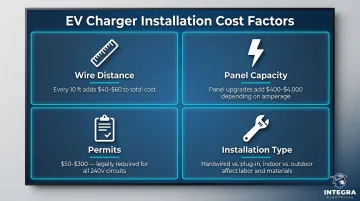
This is the single biggest variable in labor and materials cost. A charger installed on the wall directly above the panel might require just 5 feet of wire, while a garage on the far side of the house could need 60–80 feet.
According to Home Depot pricing data, 6/3 NM-B stranded copper wire (commonly used for 50A circuits) costs approximately $3.97 per foot. When you factor in labor and conduit for long runs, that 60–80 foot distance can easily add $1,000–$1,500 to the baseline cost.
Cost-saving tip: Position the charger on the garage wall closest to your basement or exterior electrical panel to minimize linear-foot material and labor adders.
Your Home's Electrical Panel Capacity
A Level 2 charger requires a dedicated 40–60 amp circuit. Homes with older or smaller panels — 60–100 amp service, common in Des Moines homes built before 1990 — may not have the capacity without an upgrade.
Data from Qmerit shows that 20% of homes require an electrical panel upgrade before installing an EV charger. Upgrade costs vary by scope:
- Subpanel addition: $400–$1,750
- Full service upgrade to 200 amps: $1,500–$4,000+
According to the Iowa Community Indicators Program, the median year a housing structure was built in Polk County is 1974, and 37.5% of Des Moines housing units were built before 1940.
family-owned Integra Electrical's complimentary (zero-cost) Safety Evaluation using a Digital Voltage Analyzer assesses panel capacity and any electrical risks before any work begins, so homeowners know exactly what they're dealing with upfront — no mid-project surprises.
Permits and Local Code Requirements
Most jurisdictions require a permit for any new 240V circuit. Permit fees range from $50–$300 and are usually handled by the electrician.
Nationally, permit fees average $297, though some jurisdictions charge as little as $45 or as much as $720. Skipping a permit voids warranties and creates liability risk if something goes wrong.
Installation Complexity
Additional cost factors include:
- Hardwired installations cost $100–$200 more than a plug-in NEMA outlet setup — but offer a cleaner, permanent solution
- Outdoor installations require weatherproof equipment and conduit, pushing costs higher than interior installs
- Finished drywall requires careful wire fishing and patching — exposed studs or basement runs are faster and cheaper
What's Actually Included in an EV Charger Installation Quote
A standard electrician's quote for EV charger installation covers more than just mounting the unit, but what's included varies by contractor. Always ask for a line-item breakdown before signing anything.
Typical Line Items in a Professional Installation Quote
- Licensed electrician labor (2–6 hours depending on complexity)
- Electrical wiring and conduit materials
- Dedicated circuit breaker installation
- Permit fees (sometimes separate — always ask)
- Testing and safety verification
- Minimum 1-year labor warranty
What's Typically Not Included
Ask specifically about these before signing:
- The charger unit itself (some quotes include it, many don't)
- Electrical panel upgrades if capacity is insufficient
- Major construction like drywall repair, painting, or underground trenching
- Specialty equipment like load management systems or multiple chargers
Getting that full picture upfront — labor, materials, permit fees, and any panel work — is the only way to compare quotes accurately across contractors.
How to Lower Your EV Charger Installation Costs
A few smart decisions before the install date can meaningfully cut what you pay. These three strategies cover placement, available incentives, and how to find the right electrician.
Minimize Wire Runs and Confirm Panel Capacity
Placement matters:
- Position the charger as close to the electrical panel as practical
- Every additional 10 feet of wire adds $40–$60 in materials plus labor
- Confirm your panel has available capacity before scheduling to avoid upgrade costs
- If you're already planning a panel upgrade or other electrical work, bundle the EV install at the same time to save on trip charges and labor
Take Advantage of Federal and Utility Incentives
Federal 30C Alternative Fuel Infrastructure Tax Credit:
- Covers 30% of installation costs (labor and materials), capped at $1,000
- Applies only to installations in eligible census tracts (low-income or non-urban areas)
- Strict deadline: Equipment must be placed in service before June 30, 2026 to qualify
- File using IRS Form 8911
MidAmerican Energy Time-of-Use (TOU) Rates:
- MidAmerican Energy does not offer upfront installation rebates
- Instead, they offer Time-of-Use rates with lower electricity costs during off-peak hours (10 p.m. to 8 a.m.)
- Invest in a Wi-Fi-enabled smart charger to automate overnight charging and capture long-term savings
Get Multiple Quotes from Experienced EV Electricians
Get **two to three quotes from licensed electricians** who have specific EV charger installation experience. Electricians unfamiliar with NEC Article 625 can cause failed inspections and costly rework — vetting for that experience upfront saves money and headaches.
What Most Homeowners Get Wrong About EV Charger Costs
Focusing Only on the Upfront Installation Price
Advertised "starting at $X" figures often exclude equipment and assume ideal panel access. Homeowners should account for:
- The charger unit ($300–$800)
- Any panel work ($0–$4,000+)
- Permit fees ($50–$300)
A realistic all-in total range for most Des Moines homes is $1,200–$3,500, not the misleading "$800 starting price."
Underestimating the Electrical Panel Issue in Older Homes
Many Des Moines homeowners in homes built before 1990 discover mid-project that their panel needs upgrading, turning a $1,200 job into a $3,500 one. A panel assessment before booking the install takes about 30–60 minutes and can surface capacity issues, outdated breakers, or insufficient amperage — all of which affect your final cost. It's the single most effective step to avoid mid-project surprises.
Choosing the Cheapest Quote Without Verifying Credentials
Improper wiring of a high-draw continuous circuit creates fire risk and may fail inspection. Always check that the electrician is:
- Licensed in Iowa
- Experienced with EV installs (not just general electrical work)
- Familiar with NEC Article 625 requirements
Ignoring the NEC 80% Rule (125% Continuous Load Sizing)
Under NEC Article 625, EV chargers are "continuous loads" requiring circuit breakers sized at 125% of the charger's draw. A 48A charger requires a 60A breaker (48A × 1.25 = 60A), not a 50A breaker.
Homeowners who buy a 48A or 50A charger assuming it will work on an existing 50A circuit are setting themselves up for expensive re-work.
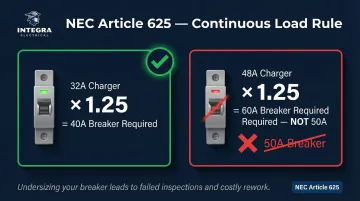
Getting a panel assessment, verifying credentials, and confirming your circuit sizing before installation day are the three steps that separate a smooth $1,500 install from a frustrating $3,500 one.
Frequently Asked Questions
How much does it cost to install a Level 2 EV charger at home?
Most homeowners pay between $1,200 and $2,800 for a standard Level 2 install (240V, 30–50 amp circuit), including the charger unit, labor, permit, and materials. Complex setups requiring panel upgrades, subpanels, or long outdoor runs can push costs above $5,000.
Is there an IRS tax credit for EV charger installation?
Yes. The 30C Alternative Fuel Infrastructure Tax Credit covers 30% of installation costs, up to $1,000. It applies to installations in eligible census tracts and expires June 30, 2026. File using IRS Form 8911.
Can a regular electrician install an EV charger?
Any licensed electrician can do this work, but hire one with specific EV charger installation experience. Knowledge of NEC Article 625, load calculations, and permit requirements is essential. Improper wiring creates fire risk and causes failed inspections.
What is the 80% rule for EV charger installation?
The 80% rule (or NEC continuous load rule) means a circuit breaker must be rated at 125% of the charger's continuous output. A 48-amp charger requires a 60-amp breaker. If your panel lacks that capacity, an upgrade is required before installation.
Does installing a Level 2 charger increase home value?
Yes. Buyers increasingly view home EV chargers as a desirable feature. Zillow research finds homes with EV charging sell 9.5–10 days faster, and Realtor.com data points to up to a 3% price premium — roughly $17,000 in added value.