Introduction
"Do I need to upgrade my electrical panel before installing a home charger?" If you're a Des Moines homeowner with an electric vehicle, you've probably asked yourself this question more than once. The answer isn't one-size-fits-all—and because panel upgrades can cost $3,000 or more, it's worth understanding your options before committing to any work.
Here's what this guide covers — whether you're in a 1970s split-level in Norwalk or a newer build in Johnston:
- How to assess your current panel's capacity
- When an upgrade is actually necessary
- Lower-cost alternatives that may work for your home
- What everything costs, so you can budget before calling an electrician
Key Takeaways
- Most 200-amp panels support Level 2 charging without upgrades
- Smart load management devices let many 100-amp homes avoid costly service upgrades
- Frequent breaker trips and flickering lights signal your panel is already stressed
- A licensed electrician's load calculation is the only way to know exactly what your home needs
- Federal Pacific and Zinsco panels must be replaced regardless of EV plans
What Your Panel Does — and Why EVs Change the Equation
Your electrical panel—also called a breaker box—receives power from the utility and distributes it across all the circuits in your home. Its amp rating sets the ceiling on how much electricity you can use at once. A 100-amp panel handles most older homes just fine — until you add something that runs hard every single night.
Level 2 Chargers Are High-Load Appliances
A Level 2 EV charger requires a dedicated 240-volt circuit drawing 30 to 50 amps, roughly equivalent to an electric dryer. Your dryer runs a few times a week for an hour. Your EV charger runs nightly for hours on end — the National Electrical Code classifies this as a "continuous load," which triggers specific sizing requirements.
Because the charger operates for three hours or longer, the circuit breaker must be sized at 125% of the charger's maximum draw (known as the 80% rule). A 40-amp charger requires a 50-amp breaker. For panels already near capacity, that dedicated circuit may not fit without an upgrade.
Service Upgrade vs. Panel Replacement
Homeowners often conflate these two, but the scope and cost differ significantly:
- Service upgrade: Increasing total amperage entering your home (e.g., 100A to 200A). This involves replacing the meter socket, service mast, wiring, and coordinating with the utility company.
- Panel replacement: Swapping out old or unsafe breaker box hardware at the same amperage. This addresses safety concerns or provides additional circuit slots without increasing capacity.
How to Tell If Your Panel Can Handle an EV Charger
Check Your Panel's Amp Rating
Open your breaker box and look at the main breaker—the large switch at the top or bottom. The amp rating is stamped on it:
- 200 amps: Handles most modern homes plus EV charging comfortably
- 100 amps: May work but requires closer scrutiny and a load calculation
- 60 amps: Insufficient for Level 2 charging and almost always requires upgrading
Load Calculations: The Only Reliable Answer
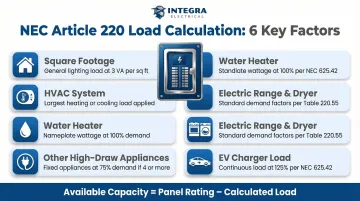
Capacity on paper doesn't equal available capacity in real life. A licensed electrician performs an NEC Article 220 load calculation, factoring in:
- Square footage
- HVAC system type and size
- Water heater (electric or gas)
- Electric range and dryer
- All other high-draw appliances
This calculation reveals how much power your home actually consumes versus how much your panel can safely deliver. Homes 30+ years old in the Des Moines area often have smaller original service and may have had circuits added over the decades without a corresponding panel upgrade, making this step especially important.
Physical Space: The Circuit Slot Check
Even if your panel has sufficient amp capacity, you need an open breaker slot for the dedicated EV circuit. If your panel is full, an electrician can:
- Install tandem breakers (two circuits in one slot)
- Rearrange existing circuits to free up space
- Add a sub-panel to create additional circuit slots
Critical caveat: Tandem breakers and sub-panels don't increase total ampacity—they only create physical space for more circuits.
Warning Signs Your Panel Is Already Stressed
If you notice any of these symptoms before adding an EV charger, an upgrade isn't optional—it's necessary:
- Breakers that trip frequently
- Lights that dim or flicker when major appliances turn on
- Outlets that don't function reliably
- Unusual warmth or burning smell near the panel
These signals indicate your panel is already operating near its limits. Adding a 40-amp continuous load will push it into dangerous territory.
Get a Professional Assessment
If any of these warning signs sound familiar—or you're simply not sure where your panel stands—the next step is a professional evaluation, not guesswork.
family-owned Integra Electrical offers a complimentary (zero-cost) Safety Evaluation before any work begins. Their licensed technicians use a Digital Voltage Analyzer to detect overloaded circuits and hidden risks. You get a clear, data-backed answer—not an estimate—before any work is scheduled or quoted.
When You Definitely Need a Panel Upgrade
Scenarios That Leave No Room for Workarounds
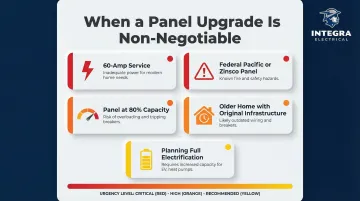
Certain situations make a panel upgrade non-negotiable:
60-Amp Service These panels simply don't have enough total capacity to safely run modern household loads alongside an EV charger. Upgrading to 200-amp service is required, not suggested. A 60-amp panel was designed for homes with minimal appliances—not homes running EVs, heat pumps, and modern appliances.
Recalled or Unsafe Panel Brands Federal Pacific Electric (Stab-Lok) and Zinsco panels carry serious safety hazards. FPE breakers fail to trip under overload conditions in up to 60% of cases; Zinsco breakers can melt and fuse to the bus bar entirely.
If your home has either brand, replace it immediately — regardless of EV charging plans. Adding more load to a compromised panel is gambling with your home's safety.
Panel Already at 80% Capacity If a load calculation reveals your household is already consuming close to the panel's rated limit, there's no safe headroom for a 30- to 50-amp EV circuit. According to a nationwide survey, approximately 31% of U.S. single-family homes still operate on 100-amp or smaller service—most common in homes built before 1960.
Older Homes with Original Infrastructure Capacity issues are especially common in Des Moines-area homes built between the 1960s and 1990s — many have aging wiring, outdated breakers, and undersized service entrances. Circuits were often added over the decades without any corresponding panel upgrade, leaving little margin for a new EV load.
Future-Proofing for Full Electrification If you plan to add a heat pump, induction range, and EV charger simultaneously, waiting until your panel is at the breaking point is costlier and riskier than upgrading now. A 200-amp panel accommodates future electrification without repeated service calls and expense.
Alternatives to a Full Panel Upgrade
Not every home needs a complete service upgrade. Several cost-effective solutions exist:
Load Management and Load-Shedding Devices
These smart devices monitor your home's real-time power consumption and automatically throttle EV charging speed when other appliances create demand spikes. NEC Article 625.42(A) explicitly permits Energy Management Systems (EMS) to limit maximum equipment load on a service and feeder.
For many 100-amp homes, these devices allow safe EV charging without a full service upgrade. The charger draws maximum power when your home's demand is low — think late-night charging — and pulls back automatically when the dryer, oven, and HVAC are all running at once.
Circuit-Sharing Arrangements
An electrician can configure your EV charger to share a circuit with another high-draw appliance that operates on a different schedule, typically an electric dryer. Hardware-enforced smart splitters automatically pause EV charging when the dryer runs, so only one high-power load operates at a time.
Sub-Panels
When your main panel has sufficient overall amperage but is physically full of breakers, a licensed electrician can add a sub-panel to create additional circuit slots. This is less expensive than a full service upgrade and especially practical for garage EV charger installations. A sub-panel costs between $400 and $2,000 versus $3,000+ for a service upgrade.
What Does an Electrical Panel Upgrade Cost in Des Moines?
Realistic Cost Ranges
A standard 100-amp to 200-amp service upgrade in Iowa typically runs between $1,200 and $3,000, depending on whether the meter base and service entrance wiring also need updating — common in older Des Moines homes.
For full-service upgrades including higher amperage tiers, Integra Electrical's pricing ranges from $3,000 to $15,000, based on amperage level, location, and installation complexity.
Costs include:
- New panel hardware and breakers
- Labor for installation
- Permits and inspections
- Utility coordination (when required)
Homes with outdated meter sockets or service masts will fall toward the higher end of the range.
Federal Tax Credits
Two federal tax credits can offset costs:
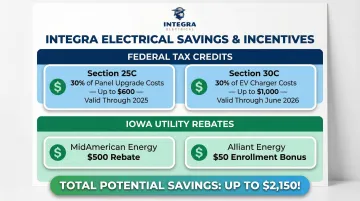
Energy Efficient Home Improvement Credit (Section 25C):
Covers 30% of panel upgrade costs up to $600 when the upgrade is done in conjunction with qualifying energy-efficient improvements. The panel must have a capacity of 200 amps or more and meet NEC standards. Valid through 2025.
Alternative Fuel Infrastructure Tax Credit (Section 30C):
Covers up to 30% of EV charger installation costs (maximum $1,000). The property must be located in an eligible low-income or non-urban census tract. Valid through June 30, 2026.
Important limitation: The 25C credit requires the panel upgrade to "enable" other qualifying energy property—you can't claim it for a standalone panel upgrade.
Iowa Utility Incentives
- MidAmerican Energy: Offers a $500 rebate for residential Level 2 charger installations
- Alliant Energy: Offers a $50 enrollment bonus for joining their Smart Hours demand response program
Long-Term Value
A properly sized panel isn't just about EV charging. Research published in Nature Sustainability found that homes with EV charging infrastructure command price premiums up to 3.3% — approximately $17,212 on a median-priced home.
Over a panel's 25- to 40-year lifespan, that investment also improves safety, supports future electrification, and adds measurable resale value. Spread across decades of use, the annual cost is modest — and the upside is concrete.
Frequently Asked Questions
Do I need to upgrade my electrical panel for an electric car?
Most homes with a 200-amp panel do not need an upgrade. Homes with 100-amp panels may need one or a smart alternative, while 60-amp panels almost always require upgrading. Only a load calculation by a licensed electrician can answer this for your home.
Is a 100 amp panel enough for an EV charger?
A 100-amp panel can often support Level 2 charging with smart load management devices, but it depends on how much electricity your home already uses. A licensed electrician's load calculation will determine the best path forward.
How do I know if my electrical panel needs upgrading?
Key indicators include: panel rated below 200 amps, breakers that trip frequently, lights that flicker when appliances run, or a recalled panel brand like Federal Pacific or Zinsco. Any of these signs warrant a professional assessment.
What is the 80% rule for EV charging?
The NEC's 80% rule requires that a continuous load like an EV charger not exceed 80% of the circuit's rated capacity. A 50-amp circuit, for example, can only safely deliver 40 amps to the charger. If your panel is already running close to capacity, that same threshold applies when determining whether an upgrade is needed.
How much does it cost to upgrade an electrical panel for EV charging?
Panel upgrades (hardware, labor, and permits) typically cost $1,200 to $3,000 for a 100A-to-200A service upgrade. Federal tax credits can offset up to $600 of the cost, though final costs vary based on your home's age and existing infrastructure.
Can I upgrade my electrical panel without rewiring my house?
Yes, in most cases. A panel upgrade replaces the breaker box and possibly the service entrance, but does not require rewiring the entire home's branch circuits unless the wiring itself is found to be damaged or non-compliant during inspection.
Ready to find out if your home is EV-ready? Integra Electrical's licensed technicians serve Des Moines-area homeowners with a complimentary Safety Evaluation that includes a full load assessment — so you get a clear answer about your panel before any work begins. Call (515) 442-0025 (Des Moines metro, Indianola, Clive, and West Des Moines) or visit integraelectrical.com.