Introduction
Many Des Moines homeowners with older properties don't think about their electrical panel until something goes wrong—a breaker that won't stop tripping, lights that flicker when the AC kicks on, or a home inspector flagging the panel as outdated. Yet this metal box, often tucked away in a basement or garage, controls how safely and reliably electricity reaches every corner of your home.
An electrical panel serves as your home's central distribution point, routing power from the utility line to individual circuits throughout the house. As homes age and electrical demands grow—with modern appliances, EV chargers, smart devices, and heat pumps—panels designed for the 1970s or 1980s often struggle to keep up.
According to the National Association of Home Builders, the median age of owner-occupied homes in the U.S. reached 40 years old in 2022. That means many Des Moines properties have panels well past their prime.
This guide covers warning signs, an honest look at pros and cons, realistic Des Moines cost ranges, what the process looks like, and how to decide if an upgrade makes sense for your home.
TLDR: Key Takeaways
- Most Des Moines homeowners pay $1,500–$4,000; costs climb if a utility service upgrade is also needed
- Warning signs include frequent breaker trips, burning smells, and panels 25–40+ years old
- Main benefits: improved safety, added capacity, smoother home sales, and potential insurance savings
- Main downside: upfront cost and a full-day power outage during installation
- A 100-amp to 200-amp upgrade qualifies for a federal tax credit of up to $600 through 2025
Signs Your Electrical Panel Needs an Upgrade
Some warning signs require immediate professional attention, while others signal a planned upgrade is wise. Knowing the difference helps homeowners act at the right time without unnecessary delay.
Safety Red Flags That Need Immediate Attention
Burning smells, the odor of melting plastic, or buzzing, crackling, and sizzling sounds coming from your panel are not minor issues. They indicate arcing or overheating inside the panel — a fire and shock hazard that requires same-day professional evaluation.
According to the National Fire Protection Association, U.S. fire departments responded to an estimated 46,700 home fires involving electrical failure or malfunction annually between 2015 and 2019, with electrical distribution equipment accounting for 49% of these fires.
Visible burn marks on breakers, rust or corrosion on panel components, or signs of moisture intrusion compromise the panel's internal components and can cause dangerous failures even without obvious symptoms. These conditions allow current to flow improperly, creating heat and increasing fire risk.
Performance and Capacity Warning Signs
A breaker tripping once is normal. A breaker tripping repeatedly on the same circuit means the panel can no longer safely handle that load — and the problem won't fix itself.
Other capacity warning signs include:
- Dimming or flickering lights when running appliances simultaneously
- Outlets losing power intermittently
- Appliances underperforming (weak AC, slow electric dryer)
- The need to unplug one appliance to safely run another
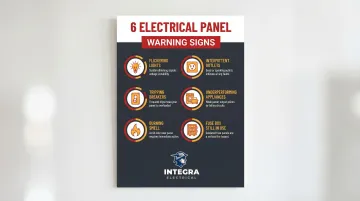
Homes still running a fuse box rather than a circuit breaker panel are using an outdated system that cannot safely handle modern electrical loads and should be replaced regardless of other warning signs.
Age and Planned Home Upgrades
Electrical panels have a typical lifespan of 25–40 years. A panel in that range or older should be professionally inspected even without visible problems — this is especially relevant for Des Moines homeowners with homes built in the 1980s or earlier.
Planning any major addition — EV charger, solar panels, central AC, a home addition, or high-draw workshop equipment — requires confirming the existing panel can handle the new load safely before work begins. A Level 2 EV charger alone can draw 30–50 amps continuously, which would overload many older 100-amp panels already serving a full household.
If any of these situations sound familiar, family-owned Integra Electrical's complimentary (zero-cost) Safety Evaluation is a practical first step. It uses a Digital Voltage Analyzer to detect overloaded circuits and hidden risks, giving you an honest picture of the panel's condition before committing to any work.
Pros and Cons of an Electrical Panel Upgrade
Not every homeowner has a choice—some panels must be replaced for safety—but for those weighing the decision, understanding the real benefits and honest drawbacks makes for a smarter choice.
The Pros
- Improved safety: Meets current NEC codes, replaces breakers that may fail to trip, and removes fire risks from corroded or overloaded components. Also eliminates hazardous legacy panels like Federal Pacific Electric (FPE) Stab-Lok and Zinsco models, which are flagged by insurers as unacceptable fire liabilities.
- Increased capacity: A 200-amp panel supports EV chargers, heat pumps, solar systems, and additional circuits—giving the home room to grow as electrification needs increase.
- Smoother resale: An updated panel prevents failed inspections and lender or insurance rejections. Sellers who address electrical issues proactively avoid buyer concessions and deals falling through at closing.
The Cons
Upfront cost is the primary barrier. Most residential upgrades run $1,500–$4,000, and projects requiring a utility service upgrade (the lines running to your home) can push into the $5,000–$25,000 range, making professional assessment of scope essential before budgeting.
The project requires pulling permits, coordinating with the utility in some cases, and involves a full-day power outage. In Des Moines, electrical permits start at $75 for alterations, and the State of Iowa requires inspections for service upgrades, with inspectors having three business days to respond. In some regions, utility scheduling backlogs can delay the project by weeks or months.
Not every older panel automatically needs full replacement. A 100-amp panel can sometimes still safely serve a home with thoughtful appliance choices. The decision should be based on a professional assessment, not assumption.
How Much Does an Electrical Panel Upgrade Cost?
The typical cost range for a residential panel upgrade in Des Moines runs $1,500–$4,000, covering panel equipment plus labor. The main factors that push costs up or down include local labor rates, panel amperage being installed, whether additional circuits are needed, and—most significantly—whether a utility service upgrade is required. The best way to understand actual project cost is to get multiple quotes from licensed electricians.
Cost by Panel Size
Here's what Des Moines homeowners can expect by amperage tier:
| Amperage | Typical Cost Range | Best Use Case |
|---|---|---|
| 100-Amp | $800–$1,500 | Small homes with minimal electrical demands |
| 150-Amp | $1,300–$1,600 | Moderate homes with standard appliances |
| 200-Amp | $1,300–$4,500 | Modern standard; supports EVs, central AC, heat pumps |
| 400-Amp | $2,000–$12,000 | Large homes, dual EVs, heavy electric heating |
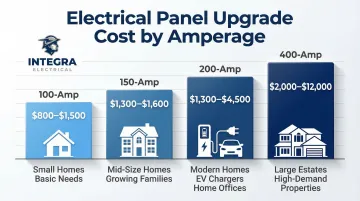
The 100-amp to 200-amp upgrade is the most common project for Des Moines-area homes, typically costing $1,500–$3,500 when the existing utility service is adequate. When a full service upgrade is required—involving utility coordination, new service drops, meter bases, or trenching—costs escalate dramatically, ranging from $5,000 to $30,000.
Labor typically represents the largest share of the cost, accounting for 60–75% of the total, because licensed electricians must safely disconnect, install, and test the panel to code. In the Des Moines-West Des Moines metro, the mean hourly wage for electricians was $31.87 as of May 2023.Those rates reflect the skill required — hiring unlicensed workers risks failed inspections, voided insurance, and real safety hazards.
Tax Credits and Financial Incentives
The federal Energy Efficient Home Improvement Tax Credit covers 30% of project cost, up to $600, for panel upgrades reaching at least 200-amp capacity when installed alongside qualifying equipment — heat pumps, EV chargers, or heat pump water heaters.
The credit expires at the end of 2025, so if you're pairing a panel upgrade with other efficiency improvements, plan ahead.
It's also worth checking MidAmerican Energy for rebates. While MidAmerican doesn't rebate panels directly, they offer $300–$713 for air-source heat pumps and $225 for heat pump water heaters in 2026 — both stackable with the federal 25C tax credit to bring your total project cost down further.
What to Expect During an Electrical Panel Upgrade
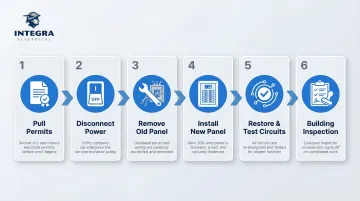
The typical sequence for a residential panel upgrade follows this pattern: permits are pulled, the electrician disconnects power to the home, removes the old panel while carefully labeling all wires, installs and wires the new panel in the same location, restores power, and tests every circuit before leaving. Most straightforward residential jobs are completed in one day.
Practical preparation for homeowners:
- Plan for a half-day to full-day without power
- Keep refrigerator and freezer closed to maintain temperature
- Arrange an alternative workspace if working from home
- Charge devices and prepare for limited lighting
- Expect a follow-up inspection from a local building official to verify the work meets code before the project is considered complete
Why this is not a DIY project: Panel work involves contact with live main service lines that cannot be turned off by the homeowner. Improper installation can be illegal, void homeowner's insurance, and create fire or electrocution hazards that may not surface immediately. In Polk County, homeowners are explicitly prohibited from performing service upgrades — a State of Iowa Licensed Electrical Contractor must obtain the permit and perform all work.
Those legal restrictions extend to your coverage, too. Insurance policies require homes to be maintained to code, and if an electrical panel malfunctions because it was improperly installed by an unlicensed homeowner, the resulting fire damage claim will be denied by the insurance carrier.
Is an Electrical Panel Upgrade Worth It?
If the panel is 30+ years old, shows any of the warning signs covered above, or the homeowner is planning to add an EV charger, solar, or major appliances, an upgrade is warranted—and delaying only increases both risk and eventual cost.
The value extends well beyond upfront cost. An upgraded panel delivers tangible benefits across safety, finances, and resale:
- Reduces electrical fire risk with modern breaker protection
- Can lower homeowner's insurance premiums — some insurers charge higher rates for outdated panels
- Supports a cleaner home inspection when it comes time to sell
- Provides confidence from a system built to current safety standards
Insurance is worth calling out specifically. Most major insurers now require a minimum of 100-amp service to issue a homeowner's policy, and homes with 60-amp service or obsolete fuse boxes are frequently flagged as inadequate and hazardous.
For Des Moines area homeowners ready to take the next step, Integra Electrical has spent over 20 years working specifically with older homes — the kind where hidden electrical issues are most common. Schedule your free safety evaluation to get an honest picture of your panel's condition before committing to any work.
Frequently Asked Questions
What is the average cost of an electrical panel upgrade?
Most Des Moines homeowners pay $1,500–$4,000 for a standard residential panel upgrade. Panel size, local labor rates, and whether a utility service upgrade is needed are the primary factors that move costs higher or lower.
How much does it cost to upgrade from a 100-amp to a 200-amp panel?
This is the most common upgrade, typically costing $1,500–$3,500 when the existing utility service is adequate. This upgrade also qualifies for the federal tax credit (up to $600) when installed with eligible energy-efficient equipment like a heat pump or EV charger.
Can you upgrade an electrical panel without rewiring the house?
In most cases, the existing wiring stays in place. Rewiring is only needed if the wiring itself is damaged, outdated (such as knob-and-tube), or if entirely new circuits are being added as part of the project.
Should a 50-year-old electrical panel be replaced?
A 50-year-old panel has exceeded its typical lifespan, likely no longer meets current safety codes, and should be professionally inspected immediately. In most cases, replacement will be recommended for safety and capacity reasons.
Does upgrading to 200-amp service increase home value?
While it may not return dollar-for-dollar, an upgraded panel prevents buyer negotiation on price, avoids failed home inspections, and is increasingly required by buyers' lenders and insurance providers, making it a practical necessity for resale.
What is the 80% rule for electrical panels?
The NEC's 80% rule states that a breaker should not carry more than 80% of its rated amperage continuously — for example, a 20-amp breaker should never run more than 16 amps for extended periods. This prevents overheating and fire risk, so a 200-amp panel can only safely deliver 160 amps of continuous power.