Electrical panel replacement costs vary widely based on panel type, amperage, labor, and additional work required. This guide breaks down what to expect in 2026 so Des Moines homeowners can budget with confidence and make informed decisions about one of the most critical safety systems in their home.
Key Takeaways
- Typical cost: $1,000–$3,000, reaching $4,500+ with wiring upgrades or relocation
- Biggest drivers: amperage, labor hours, panel type, permits, and additional wiring
- Homes 30+ years old usually need full replacement, not repair
- DIY panel work is dangerous and can void your homeowner's insurance; always hire a licensed electrician and pull proper permits
How Much Does It Cost to Replace an Electrical Panel?
There's no single fixed price for electrical panel replacement. The final cost depends on panel type, amperage required, labor rates, and whether additional work like rewiring or relocation is needed. According to Angi's 2026 data, the typical installed cost ranges from $518 to $2,187, averaging around $1,343. Complex projects involving relocation or service expansion can reach $4,500 or more.
Many homeowners get sticker shock because they only look at the panel's price tag. The box itself is cheap—it's the labor, permits, inspections, and follow-on work that drive the total. The breakdown below covers each cost driver so you can size up your project before calling a contractor.
Typical Cost Ranges by Panel Type
Different panel types come with different price points. Here's what you'll pay in 2026:
| Panel Type | Installed Cost | What It Does |
|---|---|---|
| Main Breaker Panel | $500–$2,000 | The standard modern panel; controls all circuits and disconnects power |
| Fuse Box Replacement | $1,500–$2,000 | Swap outdated fuse box for modern breakers; requires significant rewiring |
| Main Lug / Subpanel | $400–$2,000 | Secondary panel fed from main panel; adds capacity for additions or outbuildings |
| Circuit Breaker Switch | $100–$200 | Single breaker replacement; not a full panel swap |
| Electric Meter Box | $100–$650 | Replacement of the utility meter enclosure |
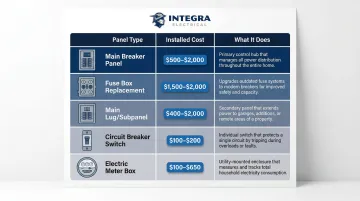
Upgrading from a fuse box to a breaker panel is a premium service because it requires rewiring to meet modern safety codes. Older homes in Des Moines with original 1960s–80s electrical systems often fall into this category.
Cost by Amperage
The panel box itself is a small part of the total cost. According to 2026 pricing data, here's what you'll pay for the panel hardware alone:
| Amperage | Parts Cost | Typical Use Case |
|---|---|---|
| 100 Amps | $100–$200 | Smaller, older homes with minimal electrical demands |
| 150 Amps | $150–$250 | Small homes running several appliances simultaneously |
| 200 Amps | $250–$350 | Current standard for modern homes; supports HVAC, appliances, tech |
| 400 Amps | $500 | Large homes, high-demand appliances, multiple EV chargers |
Most older Des Moines homes run on 100-amp service. Upgrading to 200 amps—the current standard for modern homes—is the most common request family-owned Integra Electrical handles, particularly for Des Moines homeowners adding EV chargers, heat pumps, or finishing a basement.
Labor Costs
Labor is typically the largest cost component. Licensed electricians charge $50–$150 per hour, with Des Moines metro rates landing toward the middle of that range.
How long the job takes depends on scope:
- Standard panel swap: 4–8 hours — typical for a like-for-like replacement
- Panel + rewiring: 20–30 hours — needed when outdated or damaged wiring requires correction to meet current code
The panel hardware runs a few hundred dollars. Labor, permits, and any required rewiring are what determine whether your project lands at $800 or $4,500.
What Drives the Cost of Electrical Panel Replacement?
Several technical and site-specific factors determine where your project lands on the cost spectrum — and knowing them upfront helps you budget accurately.
Panel Type and Amperage Required
Upgrading from a 60A or 100A panel to a 200A panel involves more work and materials than a like-for-like swap. The type of breakers needed also affects cost:
- Standard breakers: Used for most general circuits; the baseline option in any panel
- GFCI breakers: Required for bathrooms, kitchens, outdoor outlets
- AFCI breakers: Required for bedrooms and living areas to prevent arc faults
Local codes—not the electrician—determine which breaker types are required. Iowa adopted the 2023 National Electrical Code (NEC) effective July 1, 2025, so any project permitted after that date must meet stricter standards.
Number of Circuits
More circuits mean more breakers, more wiring connections, and more labor time. Homes with additions, finished basements, or modern appliances typically require more circuits. Each additional circuit adds both material and labor costs.
Permits and Inspections
Electrical panel work always requires a permit in Iowa. The Iowa Department of Inspections, Appeals, & Licensing (DIAL) mandates permits for any panelboard installation. In Des Moines, the permit fee is $77.25 for electrical work associated with alterations or additions.
State service fees range from $25 for 0-100A service to $35 for 101-200A service, with an additional $20 for each additional 100A increment.
Skipping permits risks failed inspections, voided homeowner's insurance, and complications during a home sale. Always confirm your contractor pulls the permit before work begins — not after.
Accessibility and Panel Location
Panels in tight crawl spaces, buried in closets, or installed outdoors cost more to work on. Relocating a panel to a better location adds significant cost—typically $1,500–$4,000, depending on distance moved and the number of circuits involved.
Outdoor relocations require complete rewiring and weatherproofing, pushing costs toward the higher end.
Condition of Existing Wiring
Panel replacement sometimes reveals wiring problems that must be fixed before the new panel can be energized. Older Des Moines homes commonly have:
- Knob-and-tube wiring: Common in pre-1950s homes; removal costs around $5,000 plus $200–$500 for permits
- Aluminum wiring: Found in homes built before 1972; homes with aluminum wiring are 55 times more likely to reach fire hazard conditions than copper-wired homes
The average cost to rewire a house is $7,000, ranging from $1,100 to $13,000 depending on size and scope. If your electrician flags either issue during the panel job, ask for a separate rewiring estimate before approving additional work — that context helps you plan, not just react.
Signs Your Electrical Panel Needs Replacing
Catch these warning signs early to prevent fires, equipment damage, and sudden outages:
- Frequent tripped breakers — Breakers that trip repeatedly signal overloaded circuits or a failing panel
- Flickering or dimming lights — Especially when running appliances; indicates insufficient capacity
- Burning smell or scorch marks — Visible damage or odors near the panel are urgent safety hazards
- Panel is hot to the touch — Panels should remain cool; heat indicates dangerous resistance or overload
- Audible buzzing or crackling — Any sound from the panel suggests loose connections or arc faults
- Power issues with multiple appliances — Can't run the dryer and AC simultaneously? You've outgrown your panel
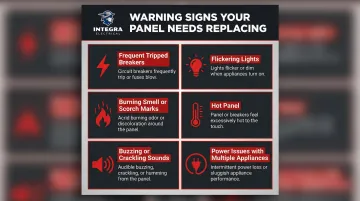
Panels older than 25–30 years (especially fuse boxes or panels from the 1960s–80s) are strong candidates for replacement even without obvious symptoms. They often can't safely support today's electrical loads.
The U.S. Fire Administration reported 23,700 residential electrical malfunction fires in 2023, causing 305 deaths, 800 injuries, and $1.5 billion in losses — many traced back to aging panels and wiring. If your home is 30 years old or older, a panel inspection isn't optional; it's overdue.
Integra Electrical offers a complimentary (zero-cost) Safety Evaluation for Des Moines area homeowners, using a Digital Voltage Analyzer to detect overloaded circuits and uncover hidden risks before they become emergencies.
Repair vs. Replace: How to Make the Right Call
Not every panel issue requires a full replacement. The right answer depends on your panel's age, condition, and what's actually wrong with it.
When Repair Makes Sense
If the panel is less than 25 years old, in generally good condition, and the issue is isolated—like a single faulty breaker—a repair costing $100–$200 may be sufficient. Simple breaker switch replacements are quick, affordable fixes.
When Replacement Is the Better Decision
Full replacement is the better call when:
- The panel is over 25 years old
- It's a fuse box
- You're experiencing recurring or multiple issues
- The panel is already near capacity
- The repair estimate approaches $1,000 or more
At that point, investing in a modern 200A panel makes more financial and safety sense than patching an aging system. Either way, this decision should always involve a licensed electrician's assessment. Getting it wrong isn't just costly—it's a fire hazard.
How to Budget Smart and Avoid Overpaying
Bundle Related Work
If the panel is being replaced anyway, consider adding outlets, upgrading the meter box, or running circuits for a new EV charger or home addition at the same time. The electrician is already on-site with the permit pulled — bundling that extra work now costs far less than scheduling a separate visit later.
Look for Available Rebates and Tax Credits
The federal Energy Efficient Home Improvement Credit (IRC Section 25C) offers a 30% tax credit, up to $600, for electrical panel upgrades through December 31, 2032. To qualify, your panel must:
- Have a capacity of 200 amps or more
- Meet the National Electric Code
- Be installed in conjunction with qualifying energy property like heat pumps or energy-efficient water heaters
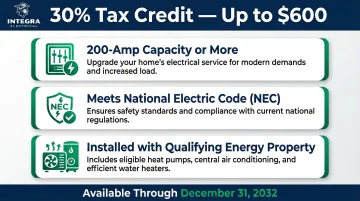
Standalone panel upgrades for general maintenance don't qualify. The credit applies only when the panel enables other energy-efficient equipment.
Get Multiple Quotes but Prioritize Licensed, Permitted Work
The cheapest quote isn't always the best deal. Ask any electrician:
- Do you pull permits for this work?
- Do you carry liability insurance and workers' compensation?
- Do you offer a workmanship warranty?
Any contractor who hesitates on those questions is worth skipping. Integra Electrical has served Des Moines-area homeowners since 2003 with upfront pricing, no hidden fees, and a 100% satisfaction guarantee — so you know exactly what you're getting before work begins.
Frequently Asked Questions
How much does it cost to replace an electrical panel?
The typical cost in 2026 is $1,000–$3,000 for the panel and installation. Costs reach $4,500 or more when rewiring or panel relocation is needed. The final price depends on panel type, amperage, labor rates, and whether additional electrical work is required.
How much does it cost to upgrade from 100 amp to 200 amp service?
Upgrading from 100A to 200A typically costs $1,300–$3,000, depending on labor, permits, and whether wiring upgrades are needed. This is the most common panel project for older homes adding modern appliances, HVAC systems, or EV chargers.
Can I upgrade my electrical panel without rewiring my house?
In most cases, rewiring is not necessary. If existing wiring is in good condition, an electrician can upgrade the panel without a full rewire. Your electrician will assess the wiring during the project and flag anything that needs attention.
What are common signs of an outdated electrical panel?
Key warning signs include frequent breaker trips, flickering lights, burning smells, a hot or buzzing panel, and having a fuse box—especially in homes 30+ years old. Any of these symptoms warrant an immediate professional inspection.
Is it worth replacing or upgrading my electrical panel?
Absolutely. A modern panel improves safety, supports today's electrical demands, may lower insurance costs, and increases home value. Panels over 25 years old or those showing warning signs should be addressed promptly to prevent fires and equipment damage.
Does homeowners insurance cover electrical panel replacement?
Homeowners insurance does not cover panel replacement due to age or normal wear. It may cover damage from a specific event like a lightning strike or fire, but routine replacements are out-of-pocket expenses.
Not sure where your panel stands? Integra Electrical serves the Des Moines metro with honest guidance and code-compliant installations backed by a 100% satisfaction guarantee. Schedule your complimentary Safety Evaluation by calling (515) 442-0025 (Des Moines metro, Indianola, Clive, and West Des Moines) or visiting www.integraelectrical.com.
![How Much Does Knob and Tube Wiring Replacement Cost? [2026]](https://file-host.link/website/integraelectrical-16yffv/assets/blog-images/4ffea801-0d11-4db1-add1-ac0ae1f15b25/1776208545016665_9d9bebcd7c5046b69b1bf999c2017ad2/1080.webp)