Introduction
Installing a Tesla home charger isn't just a luxury—it's a necessary investment for EV ownership. For Des Moines homeowners, 2026 brings both urgency and opportunity: a federal tax credit covering 30% of installation costs expires June 30, and interest in at-home charging solutions continues to climb as more families make the switch to electric.
The challenge? Total costs vary wildly. A straightforward install in a modern home might run under $1,000, while older properties requiring electrical upgrades can hit $3,500 or more. Most first-time buyers budget for the charger hardware alone—then get blindsided by labor, materials, and panel work.
By the end of this guide, you'll know exactly what drives those costs, which line items are negotiable, and what to ask your electrician before anyone picks up a tool.
Key Takeaways
- Typical all-in cost: $1,200–$2,000 for most homeowners (hardware + labor + permit)
- Simple installs run $700–$1,200; complex jobs with panel upgrades reach $3,500+
- Tesla Wall Connector hardware: roughly $450; the rest is labor, materials, and your home's electrical readiness
- Biggest cost drivers: older panels and distance from electrical panel to parking spot
- 30% federal tax credit (up to $1,000) expires June 30, 2026
- Always use a licensed electrician, pull a permit, and get at least three written quotes
How Much Does a Tesla Home Charger Installation Cost?
There's no single fixed price for Tesla home charger installation. Your final bill depends on your home's electrical system, installation complexity, local labor rates, and whether upgrades are needed — and many Des Moines homeowners budget only for the $450 Wall Connector, then get surprised by $300–$2,400+ in labor, materials, and panel work.
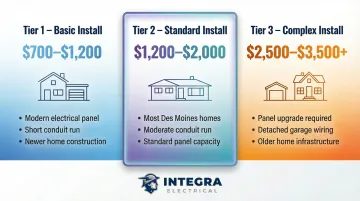
Here's how the three cost tiers break down at a glance:
| Tier | Scenario | Total Cost | Best For |
|---|---|---|---|
| Tier 1 | Basic install | $700–$1,200 | Newer homes, panel near garage |
| Tier 2 | Standard install | $1,200–$2,000 | Most Des Moines homes |
| Tier 3 | Complex install | $2,500–$3,500+ | Older homes, detached garages |
Tier 1: Basic Install ($700–$1,200)
This scenario applies to newer homes with favorable conditions:
- Modern 200A panel with open breaker space
- Panel located on the same wall as parking spot
- Short conduit run (5–15 feet)
- No drywall work required
- Minimal permit cost
What's included:
- Hardware: ~$450
- Labor: $200–$500 (2–4 hours)
- Permit: ~$75–$150
Who qualifies: Homes built after 2000, attached garages with the panel nearby, and straightforward electrical access.
Tier 2: Standard Install ($1,200–$2,000)
This is the most common outcome for Des Moines homeowners with reasonably updated panels:
- Panel and charger on different walls or across garage
- 20–40 ft conduit run
- Minor drilling or routing required
- Standard permit and inspection
What's included:
- Hardware: ~$450
- Labor: $500–$900 (4–6 hours)
- Materials: $200–$350
- Permit: $75–$200
Who qualifies: Homes built in the 1990s–2010s, attached garages where the panel isn't immediately adjacent, and situations requiring modest conduit routing.
Tier 3: Complex Install ($2,500–$3,500+)
Homes 30+ years old in the Des Moines metro are the most likely candidates here:
- Older 100A panel requiring upgrade
- Detached garage requiring trenching
- Long wire runs through finished walls or attics
- Extensive permit and inspection requirements
What's included:
- Hardware: ~$450
- Panel upgrade: $1,000–$3,000+
- Labor: $1,000–$2,400
- Materials: $300–$600
- Permit: $100–$300
The panel upgrade alone is often the biggest variable. According to nationwide housing data, 31% of U.S. homes have electrical panels rated at 100A or less — a limitation that blocks adding new high-amperage circuits without an upgrade first.
Key Factors That Affect Tesla Home Charger Installation Cost
Four variables account for most of the cost spread between a $300 install and a $3,000+ one: panel capacity and age, distance between panel and parking spot, wire routing through the home, and local labor and permitting rates. Understanding where your home falls on each factor is the fastest way to size up your budget before getting quotes.
Panel Capacity and Age
A Tesla Wall Connector requires a dedicated 240V circuit with up to a 60A breaker. Homes with older 60A or 100A panels—or panels already maxed out with breakers—typically need a subpanel or full upgrade before installation can proceed.
Local housing data shows the median year built for Des Moines housing units is 1955, and roughly 80.6% were built before 1990. Those older panels often lack the capacity or safe margin for a high-amperage EV circuit.
Research indicates that about 20% of homes require electrical upgrades before installing an EV charger — which is why family-owned Integra Electrical includes a complimentary (zero-cost) Safety Evaluation using a Digital Voltage Analyzer before any work begins, catching capacity issues before they turn into mid-project cost surprises.
Distance from Panel to Parking Spot
Copper wire and conduit are priced by the foot. Every additional 10–20 feet of run adds materials and labor cost.
| Run Distance | Typical Added Cost |
|---|---|
| 5–15 feet | $50–$100 |
| 20–40 feet | $150–$300 |
| 60+ feet (detached garage) | $500–$1,200+ |
A detached garage 60+ feet from the panel can add $500–$1,200 to your total before a single wire is pulled — and that distance also shapes which routing method is practical, which drives another layer of cost.
Wire Routing and Wall Type
Routing conduit along an exposed garage wall is fast and cheap. Snaking wire through finished ceilings, exterior stucco, or underground adds significant labor time, patching costs, and sometimes permit complexity.
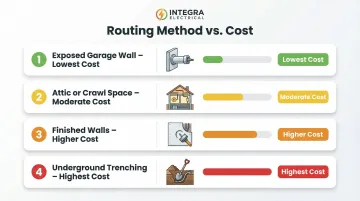
Routing scenarios ranked by cost:
- Exposed garage wall — Conduit runs visible along the surface; fastest install, lowest cost
- Attic or crawl space — Wire stays hidden but requires more labor to route and secure
- Finished walls — Drywall must be cut, patched, and repainted; adds time and material cost
- Underground trenching — Excavation, conduit burial, and surface restoration push this to the highest cost tier
Local Labor Rates and Permitting
Electrician hourly rates vary by market. According to Bureau of Labor Statistics data, the mean hourly wage for electricians in the Des Moines-West Des Moines metro is $31.87, with a median of $32.98. Iowa's statewide mean is $30.68.
Note: These are wage rates, not fully burdened contractor billable rates, which typically run 1.5–2× higher.
Permit fees in Iowa municipalities:
- Des Moines: Base electrical permit fee is $77.25, plus unit fees
- West Des Moines: Residential electrical permit for altered circuits (1-4) is $78.65
- Indianola, Norwalk, Johnston: Permits and inspections required; fees vary
Permit costs typically range $50–$200 but vary by city.
Full Cost Breakdown: What You're Actually Paying For
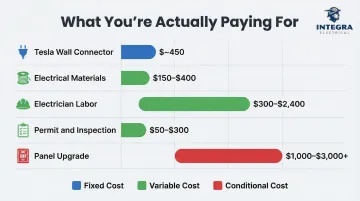
The total cost goes beyond the Wall Connector sticker price. Here's what every line item covers:
| Cost Item | Typical Range | Notes |
|---|---|---|
| Tesla Wall Connector hardware | ~$450 | Fixed MSRP from Tesla's store |
| Electrical materials | $150–$400 | Wire, conduit, breaker, fittings |
| Electrician labor | $300–$2,400 | Depends on install complexity |
| Permit and inspection fees | $50–$300 | Varies by municipality |
| Panel upgrade (if needed) | $1,000–$3,000+ | Not required for every home |
Tesla Wall Connector hardware
- Purchased from Tesla's online store at approximately $450
- This is the one fixed cost — it doesn't vary by location or install complexity
Electrical materials (wire, conduit, breaker, fittings)
- Typically $150–$400, depending on circuit amperage and run length
- 6 AWG copper wire (required for 60A circuit): $1.24–$1.88 per foot
- 3/4" PVC conduit: ~$0.71 per foot
- 60A double-pole breaker: ~$17
Electrician labor
- Straightforward install (2–6 hours): $300–$900
- Complex installs: $1,000–$2,400 (attic work, trenching, long wire runs)
Permit and inspection fees
- Typically $50–$300 depending on your municipality
- Skipping the permit is not a savings — it can void rebates, create insurance issues, and cause problems at resale
Electrical panel upgrade (if required)
This is the line item that separates a basic install from a major project — and it's the one most homeowners don't anticipate.
- Required when the existing panel can't support the added load
- Cost: $1,000–$3,000+
- Homes built before 1990 are most likely to need one, especially those still running 100-amp service
What to Know About Tax Credits and Rebates in 2026
Federal Alternative Fuel Refueling Property Credit (IRS Form 8911)
The federal 30C tax credit covers 30% of total equipment and installation costs, up to $1,000, for qualifying home EV charger installs.
Critical deadline: This credit currently runs through June 30, 2026. Homeowners who delay past that date may lose access.
Eligibility requirements:
- Property must be installed at your primary residence
- Must be located in an eligible census tract (low-income or non-urban)
- Eligible costs include the charger, labor, and related materials like conduit, wiring, and panel work dedicated to the charger
State and Utility Incentives
Iowa state-level rebates: As of early 2026, Iowa does not offer state-level EV charger rebates or tax credits for residential installations.
Utility rebates:
- Alliant Energy: Residential EV charger rebate program has been discontinued
- MidAmerican Energy: No active upfront residential EV charger rebates available for 2026, but offers Time-of-Use rates allowing off-peak charging savings (10 p.m.–8 a.m.)
Practical Paperwork Tip
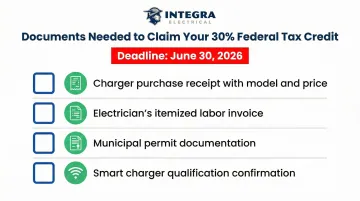
Claiming the federal 30C credit — or any future state incentive — requires solid documentation from the start. Hold onto:
- Charger purchase receipt showing the model and price
- Electrician's labor invoice with a breakdown of work performed
- Permit documentation from your local authority
- Confirmation that your charger qualifies as a smart charger (network-connected) per IRS guidelines
What Most Homeowners Get Wrong About Tesla Charger Installation Costs
Budgeting Only for the Hardware
Many buyers see the $450 Wall Connector price and mentally close the budget there, not accounting for the $300–$2,400+ in labor and materials that makes installation possible. The charger is roughly 20–40% of the total bill.
Skipping the Panel Evaluation
Homeowners with older electrical systems who skip a panel assessment before installation often face mandatory panel upgrades mid-project—an expensive surprise that a quick evaluation would have caught.
Before signing any installation contract, have a licensed electrician assess your panel. Integra Electrical offers a complimentary Safety Evaluation that identifies whether your existing panel has adequate capacity and safe margin for a 60A circuit.
Ignoring Permitting Requirements
Unpermitted EV charger installations can:
- Void homeowner's insurance coverage for related incidents
- Jeopardize rebate eligibility
- Create disclosure headaches at resale
Iowa requires electrical permits and inspections for EV charger installations. A permitted and inspected installation is the only safe path.
Not Getting Multiple Quotes
For the exact same scope of work, licensed electricians in the same market can quote prices that differ by 30–50%. Getting at least three written, itemized estimates is the most reliable way to avoid overpaying.
Frequently Asked Questions
What is the average cost to install a Tesla home charger?
The typical all-in range is $1,200–$2,000 for most homeowners, covering hardware, labor, materials, and permit fees. Simple installs in favorable conditions can come in closer to $700–$1,200, while complex jobs requiring panel upgrades can exceed $3,500.
Do I need an electrician to install a Tesla charger?
Yes, a licensed electrician is required for both safety (240V high-amperage wiring) and compliance. Professional installation ensures the work is permitted, inspected, and eligible for tax credits and rebates. DIY installation voids warranties and creates serious safety and legal risks.
Does a Tesla home charger need its own circuit?
Yes, a Tesla Wall Connector requires a dedicated 240V circuit with its own breaker (typically 60A). Sharing a circuit with other appliances is neither safe nor code-compliant, and can overload your electrical system.
Is a Level 2 home charger worth it?
For most Tesla owners who charge at home regularly, a Level 2 setup pays for itself quickly. The Wall Connector adds up to 44 miles of range per hour at 11.5 kW output, compared to 2–3 miles per hour on a standard 120V outlet.
Is charging a Tesla actually cheaper than gas?
Yes. Home charging a Tesla Model 3 costs roughly $0.032 per mile based on Iowa's residential electricity rate of 12.83 cents per kWh. Driving a comparable gas-powered sedan at Iowa's average gas price of $3.672/gallon runs about $0.115 per mile—72% more expensive.
Does installing a Tesla home charger require a permit in Iowa?
Yes, most Iowa municipalities require a permit for Level 2 EV charger installation. A licensed electrician will handle the permit application and final inspection scheduling as part of the job, ensuring code compliance and protecting your investment.