Introduction
Many homeowners assume their electrical system is fine because nothing has gone wrong yet — but electrical fires and shocks often stem from hidden issues that give no warning until it's too late. According to NFPA data from 2015–2019, an average of 46,700 home fires annually involve electrical failure or malfunction, resulting in 390 civilian deaths, 1,330 injuries, and $1.5 billion in direct property damage.
This guide gives homeowners a practical, room-by-room inspection checklist and explains what warning signs actually mean. It also helps you decide when a problem is a safe DIY fix and when to call a licensed electrician. If your home is 30 years or older, that distinction matters more than you might think — aging wiring and outdated components are among the most common sources of hidden risk.
Key Takeaways
- Home electrical safety inspections cover your panel, outlets, wiring, GFCI/AFCI protection, and high-risk areas like kitchens and bathrooms
- The CPSC recommends a DIY walkthrough every 6 months — and professional inspections every 10 years, especially for homes over 30 years old
- Key warning signs: warm outlets, burning smells, flickering lights, frequent breaker trips, discolored switches
- DIY checks catch visible warning signs — but hidden wiring faults and overloaded circuits require professional testing equipment to find
- If anything raises concern, stop using the affected circuit and contact a licensed electrician immediately
What to Inspect: Your Room-by-Room Electrical Safety Checklist
Before you start, gather a few basics:
- Flashlight (basements and garages are often dim)
- Outlet tester (available at hardware stores for under $15)
- Pen and paper to note anything that needs follow-up
Do not open the electrical panel yourself — a visual inspection from the outside is all a homeowner needs to do here.
Electrical Panel and Circuit Breakers
Visually inspect the outside of the panel for signs of rust, scorch marks, or heat damage. Check whether all breakers are properly labeled. Note any breakers that trip frequently or fail to reset — these are not normal and suggest an overloaded or faulty circuit.
Confirm the panel is accessible (not blocked by shelving or stored items) and that the area around it is dry. If your home still has a fuse box rather than a circuit breaker panel, note this as it likely requires a professional upgrade assessment. CPSC warns that older fuse panels allow for over-fusing — installing a higher-ampere fuse than the wiring can handle — which is a dangerous fire hazard.
High-risk panel brands to identify:
- Federal Pacific Electric (FPE) Stab-Lok: Breakers fail to trip during overload conditions at rates substantially higher than code-compliant devices
- Zinsco (GTE-Sylvania): Aluminum bus bars react with copper components, causing breakers to melt and fuse to the bus bar, preventing tripping
Both panels present severe failure-to-trip hazards. Insurance providers frequently deny coverage for properties containing these panels.
Outlets, Switches, and Visible Wiring
Test every outlet using an inexpensive outlet tester to check for proper grounding and correct wiring polarity. Inspect outlet and switch faceplates for discoloration, burn marks, or warmth to the touch — any of these indicate a problem. Check that outlets near water sources (sinks, tubs) are GFCI-protected.
While you're walking the home, keep an eye out for:
- Exposed or frayed wiring in closets, basements, or behind appliances
- Cords running under rugs, behind furniture, or near heat sources
- Extension cords being used as a permanent power solution (a consistent fire risk)
GFCI and AFCI Protection
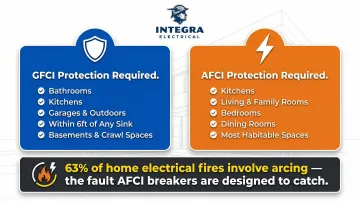
GFCI (Ground Fault Circuit Interrupter) outlets protect against electrocution by shutting off power when they detect current leakage. The 2023/2026 NEC requires GFCI protection for:
- Bathrooms, kitchens (all receptacles), garages, outdoors
- Within 6 feet of any sink
- Basements (finished and unfinished) and crawl spaces
- Laundry areas
Test each GFCI outlet using its built-in "Test" and "Reset" buttons — the outlet should cut power when Test is pressed and restore it when Reset is pressed. A GFCI that doesn't respond should be replaced immediately. CPSC and manufacturers recommend testing every GFCI at least once a month.
AFCI (Arc Fault Circuit Interrupter) breakers detect dangerous electrical arcing from damaged wiring that standard breakers miss. Modern code requires AFCI protection in kitchens, family rooms, dining rooms, living rooms, bedrooms, and most other habitable spaces. Many older homes lack them entirely, which is a significant hidden risk. According to the NFPA, arcing was the heat source in 63% of home fires involving electrical failure or malfunction — making AFCI protection one of the more critical upgrades in older homes. Test AFCI breakers monthly following the manufacturer's instructions.
Kitchen, Bathrooms, and Outdoor Areas
Kitchen:
- Unplug countertop appliances when not in use
- Keep cords away from stove and sink
- Ensure large appliances aren't running off extension cords
Bathroom:
- Unplug all small appliances (hair dryers, curling irons) when not in use
- Never use portable heaters without GFCI outlet protection
Outdoors:
- Confirm all exterior outlets have weatherproof covers and are GFCI-protected
- Inspect cords for outdoor tools for cracking or exposed wiring
- Extension cords used outdoors must be rated for outdoor use (look for the "W" designation like SJTW or SJTOW) — indoor cords deteriorate and become fire hazards in weather exposure
Warning Signs That Require Immediate Attention
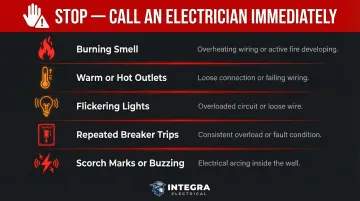
Some findings during a self-inspection are serious enough to warrant stopping use of the affected circuit right away and calling a licensed electrician — not in a few weeks, but as soon as possible.
Don't wait on any of the following — each one points to a condition that can start a fire or fail without warning:
- Burning smell from an outlet, switch, or panel — overheating wiring or components, potentially a fire already developing. Turn off the circuit breaker for that area immediately and leave it off until an electrician inspects it.
- Outlets or switches that are warm or hot to the touch — normal outlets are always cool. Warmth points to a loose connection, overloaded circuit, or failing wiring inside the wall. Dimmer switches can run slightly warm, but if a dimmer is too hot to hold your finger against, it's a fire hazard.
- Flickering or dimming lights when a large appliance kicks on — usually means the lights share a circuit with a high-draw appliance, or the panel can't handle the total load. Persistent flickering with no appliance connection can indicate a loose wire or deteriorating wiring.
- A breaker that trips repeatedly on the same circuit — a single occasional trip is normal. Repeated trips on the same circuit mean it's consistently overloaded or has a fault. Resetting it without investigating masks a dangerous condition.
- Discoloration, scorch marks, or buzzing/humming from outlets or switches — these are signs of electrical arcing, the same fault AFCI breakers are built to catch. Arcing can ignite wall materials with no visible flame outside the wall.
How to Interpret Your Findings
Not everything found during a self-inspection requires an emergency call — but every finding should be categorized and acted on. Minor signs ignored today often turn into costly repairs — or worse, fire hazards — down the road.
All Clear (No Issues Found)
Outlets test correctly, panel is dry and properly labeled, no discoloration or warm surfaces, GFCI outlets test properly, no burning smells. Document when you performed the inspection and schedule your next check in 6 months per CPSC guidance. ESFI recommends professional inspection every 10 years, or specifically for homes 40+ years old.
Minor Issues Requiring Monitoring or Near-Term Repair
- A single GFCI outlet that needs replacement
- A missing faceplate
- A cord running under a rug
- Bulbs installed at the wrong wattage
These don't require an emergency call but should be corrected within days to weeks — not ignored.
Findings That Require a Professional Licensed Electrician
- Any outlet that fails the outlet tester
- Warm or discolored outlets/switches
- Frequently tripping breakers
- Burning smells
- Visible frayed or exposed wiring
- Lack of GFCI protection in required locations
- A fuse box that hasn't been updated
In older homes, findings like these often indicate systemic aging issues, not just isolated problems.
Special Note for Homes 30 Years and Older
Older homes may have knob-and-tube or aluminum wiring, ungrounded two-prong outlets throughout, or undersized panels that can't handle modern electrical loads. Homes built before 1972 with aluminum branch-circuit wiring are 55 times more likely to reach "Fire Hazard Conditions" at outlets. Knob-and-tube (K&T) wiring lacks grounding and poses severe fire risks when covered by building insulation.
A homeowner checklist can surface the warning signs — but the resolution requires a licensed electrician who knows what to look for in aging systems. family-owned Integra Electrical specializes in older Des Moines homes and offers a complimentary (zero-cost) Safety Evaluation to help you understand exactly what you're dealing with before any work begins.
Common DIY Inspection Mistakes to Avoid
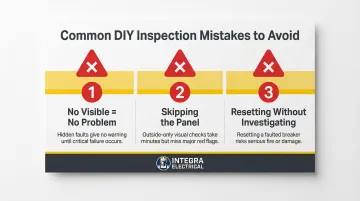
Even a careful homeowner can miss things during a self-inspection. These three mistakes are the most common — and the most consequential:
Treating "no visible problems" as a clean bill of health. Serious hazards (overloaded circuits, deteriorating insulation inside walls, loose connections) produce no visible symptoms until failure occurs. A visual inspection is a first-line screening tool, not a substitute for professional diagnostic testing.
Skipping the electrical panel entirely. Many homeowners avoid the panel out of caution — reasonable, since opening it without training isn't advised. But visually checking the outside of the panel for rust, burn marks, moisture, and labeling accuracy takes only minutes and can surface serious red flags.
Resetting a tripped breaker without investigating why it tripped. If the breaker tripped due to a fault rather than a simple overload, resetting it without resolving the cause risks fire or equipment damage. The right sequence: remove the loads on that circuit, identify the cause, then reset.
When to Call a Licensed Electrician
Call a licensed electrician rather than attempting DIY repairs when you find:
- Burning smells
- Warm outlets
- Failed GFCI tests
- Frequently tripping breakers
- Visible exposed or frayed wiring
- Two-prong ungrounded outlets throughout the home
- A fuse box still in use
Electrical work in most jurisdictions requires a permit and a licensed contractor — unpermitted work can void homeowner's insurance and create liability at resale. The Insurance Information Institute warns that unpermitted electrical work can lead to denied claims and policy cancellations.
That risk is exactly why professional inspection goes beyond anything a homeowner can catch on their own.
What a Professional Inspection Covers That DIY Cannot
Licensed electricians use tools like digital voltage analyzers and thermal imaging to detect problems that leave no visible clues at the surface:
- Overloaded circuits running near capacity
- Deteriorating connections inside walls or panels
- Hidden wiring faults from outdated installation methods
Integra Electrical offers a complimentary Safety Evaluation for Des Moines-area homeowners, using a Digital Voltage Analyzer to uncover these hidden risks — especially in homes built before 1995, where wiring standards have changed significantly.
Recommended Inspection Frequency
- Professional inspection every 10 years for most homes
- Every 5 years for homes over 40 years old
- Immediately when buying or selling a home, completing renovations, or noticing any warning signs
According to Angi (data updated April 2026), professional electrical inspection costs range from $75 to $500, with most homeowners paying an average of $150.
Conclusion
A home electrical safety inspection is one of the most reliable ways to prevent electrical fires and catch problems before they become expensive emergencies. The room-by-room checklist in this guide gives homeowners a strong starting point, but findings in older homes especially warrant professional follow-up.
If you've completed your self-inspection and found warning signs — or if your home is 30 or more years old and hasn't had a professional electrical evaluation recently — a licensed electrician can give you a definitive picture of where things stand. Integra Electrical offers a complimentary Safety Evaluation for Des Moines-area homeowners, backed by over 20 years of residential electrical experience.
Frequently Asked Questions
How often should you have a home electrical safety inspection?
The CPSC recommends a DIY self-check every 6 months. ESFI recommends professional inspection every 10 years for most homes, or specifically for homes 40 years and older. Homes with known electrical issues or those undergoing major renovations should be inspected immediately.
What is included in a home electrical safety inspection?
A professional inspection covers the electrical panel, circuit breakers, outlets, wiring, GFCI/AFCI protection, grounding, and code compliance. Electricians use diagnostic tools like digital voltage analyzers and thermal imaging cameras to detect hidden faults, then provide a written report with repair recommendations.
How do I know if my house wiring is safe?
Common warning signs include flickering lights, frequently tripping breakers, warm outlets, burning smells, and two-prong ungrounded outlets. Confirming what's inside the walls requires a professional inspection with circuit analyzers and thermal imaging — surface-level checks won't catch hidden faults.
What are the most common reasons for failing a home electrical safety inspection?
Top failure points include ungrounded outlets, missing or failing GFCI protection in required locations, exposed wiring, overloaded circuits, improperly sized breakers or fuses, and outdated wiring systems like knob-and-tube or un-remediated aluminum branch wiring.
What is the average cost for a home electrical safety inspection?
A standard professional inspection typically ranges from $75–$500, with most homeowners paying an average of $150. Costs vary by home size, age, and inspection depth. Integra Electrical offers a complimentary Safety Evaluation for Des Moines area homeowners before any work begins.
What are common electrical hazards in homes?
The most common hazards include overloaded circuits, outdated or deteriorating wiring, lack of GFCI protection near water, improper use of extension cords, ungrounded outlets, and missing AFCI protection in older homes. Most are invisible without professional testing — they won't show up on a visual walkthrough.