A licensed electrician is strongly recommended for running new circuits, working near the main panel, or wiring a detached garage. While a knowledgeable DIYer may handle limited tasks with a permit, garage wiring demands expertise that goes beyond basic electrical knowledge. This guide covers planning, National Electrical Code (NEC) requirements, the step-by-step wiring process, and how to protect your work from common mistakes.
Key Takeaways
- The 2023 NEC requires at least one dedicated 20-amp receptacle circuit, separate from lighting, in multi-bay garages
- All garage receptacles must be GFCI-protected and tamper-resistant; exterior outlets must also be weather-resistant
- Exposed NM-B (Romex) cable needs protection; conduit is required for exposed or buried sections
- Detached garages need a disconnect device and may require a subpanel if running multiple circuits
- Pull a permit and plan for future loads like EV chargers before locking in your circuit layout
Planning Before You Wire Your Garage
Successful garage wiring starts before any cable is pulled. Poor planning leads to undersized circuits, insufficient outlets, and costly rework. Two key planning steps will save you time and money: load assessment and a panel/permit check.
Assess Your Power Needs First
Walk through every planned load in your garage:
- General lighting (overhead fixtures, task lights)
- Wall receptacles for hand tools and equipment
- Power tools (table saws, compressors, welders)
- Garage door opener
- EV charger
- Heating or cooling equipment
Each load type has different amperage demands. Power tools and EV chargers often require dedicated circuits. A table saw pulling 15 amps cannot share a circuit with shop lights and a space heater without tripping breakers constantly.
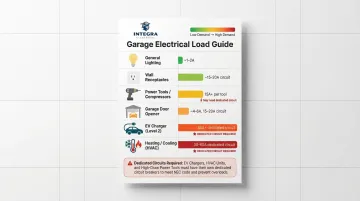
Single-circuit vs. multi-circuit setup:
- A single 20-amp circuit works only in a basic single-vehicle bay with minimal tool use
- Workshops and EV charging require multiple dedicated circuits to avoid rewiring later
Getting this right now also keeps you ahead of the permit inspection—which brings up the next step.
Check Your Main Panel and Pull a Permit
Before adding circuits, verify your main panel has available breaker slots and sufficient amperage capacity. Homes 30 years or older may have panels already near capacity or using outdated breaker types.
Approximately 29% of U.S. single-family homes operate on 100A electrical panels, and 2% have panels under 100A. Homes built before 1960 are significantly more likely to fall into that category.
For older homes especially, a panel evaluation before any garage wiring begins can prevent mid-project surprises. family-owned Integra Electrical offers a complimentary (zero-cost) Safety Evaluation using a Digital Voltage Analyzer for Des Moines area homeowners to confirm whether your existing panel can handle the added load.
Permit requirements: Most jurisdictions require an electrical permit for new circuits or garage wiring, and inspections follow. Permit rules vary by city—Des Moines area homeowners should verify with their local building or electrical inspector before starting work.
NEC Requirements for Garage Wiring
The 2023 National Electrical Code sets baseline rules for garage wiring, and local jurisdictions may adopt stricter versions. Understanding these requirements is essential before running any wire.
Branch Circuit Requirements
The NEC requires all attached and powered detached garages to have at least one 20-amp branch circuit dedicated to receptacles. In garages with more than one vehicle bay, this circuit must serve receptacles only—no lighting or other loads can be added. Single-vehicle bay garages may combine lighting and receptacles on this 20-amp circuit.
Homes built before 2017 often have only a 15-amp garage circuit — the 20-amp requirement wasn't added until 2017. That's inadequate for modern power tools or EV chargers. Any EV charger over 16 amps requires its own dedicated circuit.
Receptacle and GFCI Requirements
The NEC requires at least one receptacle per vehicle bay, mounted no higher than 5½ feet off the floor. All garage receptacles—including ceiling-mounted ones for garage door openers—must be GFCI-protected.
For accessible locations, GFCI receptacles work well since you can test and reset them easily. For inaccessible spots like ceiling outlets, a GFCI breaker at the panel is the right call.
All 15- and 20-amp receptacles below 5½ feet must be tamper-resistant. Any exterior receptacles must also be weather-resistant with in-use (bubble) covers where exposed to rain.
Lighting Requirements
The NEC requires at least one lighting outlet inside the garage, controlled by a listed wall switch. In multi-bay garages, the lighting must be on a circuit separate from the 20-amp receptacle circuit. A switch-controlled exterior light is also required at any grade-level exterior door.
Keeping lighting on its own circuit matters for a practical reason: if a GFCI trips on a shared circuit, the garage goes dark while you're working with power tools or moving around vehicles.
Step-by-Step: How to Wire an Unfinished Garage
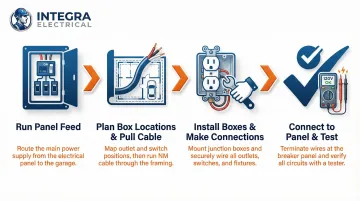
Garage wiring follows a logical sequence: plan, run feed, install boxes, pull wire, connect devices, test. Skipping or reordering steps — especially testing and inspection — often causes failures that are expensive to find later.
Step 1 — Run the Feed from the Main Panel (or Install a Subpanel)
Power is brought from the home's main panel to the garage via a new circuit breaker and cable run.
Attached garages: Typically a cable run through the wall or ceiling
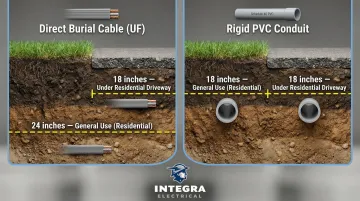
Detached garages: Underground wiring is standard, using direct-burial UF cable or THWN conductors in PVC conduit. Detached garages legally require a disconnect (either a subpanel with breakers or a dedicated 2-pole disconnect switch) immediately inside the garage entrance.
When a subpanel makes sense: If running multiple circuits (lights, receptacles, dedicated tool or EV circuit), a subpanel in the garage simplifies management, allows future expansion, and reduces strain on the main panel.
Underground wiring burial depth (NEC Table 300.5):
| Wiring Method | General Minimum Cover | Under Residential Driveways |
|---|---|---|
| Direct Burial Cable (UF) | 24 inches | 18 inches |
| Rigid Nonmetallic Conduit (PVC) | 18 inches | 18 inches |
Step 2 — Plan Box Locations and Run Cable
Before pulling wire, map box locations:
- Receptacles on each wall (per-bay minimum)
- Ceiling box for lighting
- Switch box at each entry door
- Dedicated circuit boxes for tools or EV chargers
In unfinished garages, NM-B (Romex) cable runs through drilled stud holes, not along the face of framing, per NEC protection rules.
Step 3 — Install Boxes, Devices, and Make Connections
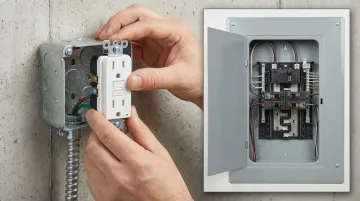
With cable runs complete, install boxes at each marked location and fasten cable with staples every 4.5 feet and within 12 inches of each box.
Then make connections:
- Connect GFCI receptacles, switches, and the lighting fixture
- Land wires correctly: hot to hot, neutral to neutral, ground to ground
- All garage receptacles must provide GFCI protection — wire accordingly
Step 4 — Connect to the Panel and Test
Land circuits at the main panel or subpanel and label each breaker clearly. Don't restore power until the testing steps below are complete.
Testing involves:
- Checking each outlet with a plug-in tester
- Confirming GFCI trip/reset function
- Verifying the lighting circuit operates from the switch
- An inspection by the local electrical inspector if a permit was pulled
Protecting Your Wiring in an Unfinished Garage
Unfinished garages create unique physical hazards for exposed wiring—ladders, tools, stored equipment, and vehicles can all damage cable. The NEC requires NM-B cable to be protected from physical damage "where necessary," and in a garage, that means nearly everywhere.
Key protection rules:
- Maintain a 1¼-inch depth from the edge of studs when drilling through framing
- Use nail plates if that depth can't be maintained
- Do not staple cable to the face of studs
- Support cable every 4.5 feet
- Run horizontal cable at or above 8 feet in unfinished walls (below 8 feet requires conduit or equivalent protection)
Some locations in a garage skip NM-B entirely and require conduit from the start:
- Underground runs
- Exposed runs on concrete block or masonry walls
- Any run within reach of vehicles or power equipment
- All exterior wiring
One material note worth flagging: PVC conduit must be rated for electrical use — plumbing PVC is not acceptable, even though the pipes look identical. Underground PVC should be buried at 18 inches depth, measured to the top of the conduit. The 2023 NEC also now explicitly requires a bushing or adapter to protect cables from abrasion where they enter and exit raceways.
Common Garage Wiring Mistakes and How to Avoid Them
Underestimating Circuit Load
Problem: Homeowner installs a single 20-amp circuit expecting to run a table saw, EV charger, and shop lights simultaneously—breaker trips constantly.
Likely cause: No load calculation was done before wiring.
Fix: Plan dedicated circuits for high-draw equipment (tools over 15 amps, EV chargers over 16 amps) during the initial design phase, not as an afterthought. EV charging is a continuous load, so NEC 625.41 requires the branch circuit and overcurrent protection to be sized at 125% of the charger's maximum output.
Skipping or Misplacing GFCI Protection
Problem: Outlets fail inspection or pose shock risk because GFCI protection was omitted, placed in an inaccessible location (like behind a freezer), or wired incorrectly (line and load terminals reversed).
Likely cause: Misunderstanding NEC accessibility rules.
Fix: Use GFCI breakers for ceiling or hard-to-reach outlets. Verify line/load wiring before energizing.
Inadequate Wire Protection in Exposed Areas
Problem: NM-B cable run along garage walls or low horizontal runs gets snagged, damaged, or fails inspection.
Likely cause: Ignoring the 8-foot rule for horizontal cable in unfinished walls, or skipping nail plates at stud penetrations.
Fix: Run horizontal cable at 8 feet or higher on open walls. Install conduit for any runs below that height or near vehicle traffic areas.
Frequently Asked Questions
What are the NEC requirements for garage wiring?
The 2023 NEC requires at minimum one 20-amp receptacle circuit, GFCI protection on all outlets, a lighting outlet controlled by a wall switch, and cable protection from physical damage. Local jurisdictions may adopt stricter versions of the code.
Do garage outlets need to be on their own circuit?
The 20-amp garage receptacle circuit must be dedicated to receptacles only in multi-bay garages (no lighting or other loads). Single-vehicle bay garages can combine lights and outlets on one 20-amp circuit. EV chargers over 16 amps always require a dedicated circuit.
Should garage outlets be 15 or 20 amp?
The NEC requires garage receptacles to be supplied by a 20-amp circuit. While a 15-amp receptacle can be installed on a 20-amp circuit, 20-amp receptacles are recommended for garages where power tools or heavy equipment will be used.
Can you run Romex in a garage without conduit?
NM-B (Romex) can run through drilled stud holes inside a garage, but conduit is required for horizontal runs below 8 feet on unfinished walls, masonry surfaces, and any underground or exterior runs. When in doubt, conduit is the safer choice.
How much does garage electrical installation cost?
Costs depend on panel capacity, number of circuits, and garage type. A dedicated circuit runs $250–$900, full garage wiring averages $865–$1,440, and subpanel installation ranges from $400–$1,750. Detached garages add $3–$12 per linear foot for underground cable runs.
What are the basic rules for wiring a garage?
All new garage wiring requires a permit and inspection — skipping this step can create problems when selling your home or filing an insurance claim. Detached garages also need a disconnect device installed at the building entrance, separate from the main panel.