Electrical upgrades serve three distinct goals: preventing hazards like fires and shocks, meeting modern energy demands, and increasing home value. This guide covers the 10 most important upgrades ranked by impact, helping Des Moines homeowners prioritize safety, reliability, and functionality.
Key Takeaways
- Panel upgrades, GFCI/AFCI outlets, and grounded wiring are the highest-priority safety fixes for homes 30+ years old
- Outdated wiring and missing surge protection are leading causes of electrical fires and expensive damage
- EV chargers, smart switches, and USB outlets add real convenience while boosting resale value
- Generators and smart smoke/CO detectors protect your household when the grid fails or danger goes undetected
- Get a complimentary electrical safety evaluation first — it shows exactly which upgrades your home needs before you spend a dollar
Safety-Critical Upgrades: The Foundation Every Home Needs
These three upgrades address the highest-risk issues — the ones that can cause electrical fires or shock injuries. For homes built before the 1980s, at least one of these is likely overdue.
Electrical Panel Upgrade
Homes built with 60- or 100-amp panels were not designed to support today's appliances, HVAC systems, smart devices, and EV chargers. A 200-amp panel is now standard for modern homes, yet many older Des Moines properties still run on 60- or 100-amp service — insufficient for today's household loads. With household electricity consumption up 43% since 1980, that shortfall creates real risk.
Upgrading to a 200-amp panel is often a prerequisite for several other upgrades on this list, including EV charging, additional circuits, and whole-home surge protection. It provides the electrical headroom needed to handle current demands safely while accommodating future needs.
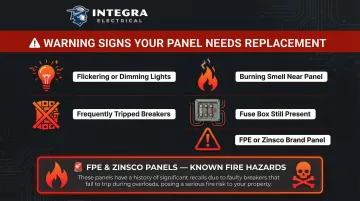
Warning signs your panel upgrade is overdue:
- Frequently tripped breakers or blown fuses
- Flickering lights when appliances turn on
- Burning smell near the panel
- A fuse box instead of a breaker panel
- Federal Pacific Electric (FPE) or Zinsco-branded panels
Federal Pacific and Zinsco panels pose documented safety risks. CPSC testing confirmed FPE Stab-Lok breakers fail UL calibration requirements, and independent testing showed 28% of tested breakers failed to trip. Zinsco panels suffer from a design flaw where circuit breakers fuse to the bus bar, causing arcing and overheating. If your home has either panel type, replacement should be a top priority.
GFCI & AFCI Outlet Protection
GFCI and AFCI protections address two separate but serious hazards.
GFCI (Ground Fault Circuit Interrupter) outlets prevent shock in wet areas — kitchens, bathrooms, garages, and outdoor spaces — by detecting ground faults and cutting power in milliseconds. Since the 1970s, GFCIs have saved thousands of lives and helped cut home electrocutions in half.
AFCI (Arc Fault Circuit Interrupter) breakers prevent arc faults, a leading cause of electrical fires, especially in bedrooms and living areas where damaged cords or faulty connections can ignite.
Both protections are now code in Iowa. The state adopted the 2023 National Electrical Code effective July 1, 2025, which mandates:
- GFCI protection for 125V–250V receptacles in bathrooms, garages, outdoors, crawl spaces, basements, kitchens, and areas with sinks
- AFCI protection for 120V, 15A and 20A branch circuits in kitchens, bedrooms, living rooms, dining rooms, hallways, and laundry areas
Homes built before the 1990s often lack both. Existing structures aren't legally required to retrofit them, but retrofitting both is worth the investment — especially if you're upgrading other systems or preparing to sell.
Grounded Outlets (Replacing Two-Prong Outlets)
Two-prong ungrounded outlets — common in pre-1960s homes — lack the third grounding wire that safely redirects excess electricity. They're a shock and fire risk, especially when modern three-prong appliances are connected through adapters.
Swapping the outlet face doesn't fix the underlying wiring problem. Replacing a two-wire receptacle without providing an equipment ground or GFCI protection is a serious NEC violation. A licensed electrician needs to assess the circuit — and may recommend a code-compliant alternative, such as a GFCI outlet marked "No Equipment Ground."
Protection & Reliability Upgrades: Guarding Against Hidden Hazards
Once foundational safety issues are addressed, these upgrades protect your home, your electronics, and your family from damage that can build up silently over time.
Whole-Home Surge Protection
Whole-home surge protectors differ fundamentally from plug-in power strips. These units install directly at the electrical panel and intercept voltage spikes before they reach any outlet or device in your home, protecting your entire electrical system at once.
Surges don't just come from lightning. Manufacturers estimate that external surges account for only about 20% of surge activity in a home. Internal events — utility grid switching, large appliances cycling on, neighborhood grid fluctuations — are actually the bigger threat.
Each small surge degrades circuitry over time, shortening the lifespan of TVs, computers, appliances, and HVAC systems.
Insured losses from residential power surges exceed $1 billion annually. A whole-home surge protector, installed at your panel, is one of the most cost-effective upgrades you can make.
Electrical Wiring Update / Rewiring
Older wiring types pose serious fire risks. Homes wired with aluminum branch circuits before 1972 are 55 times more likely to reach "Fire Hazard Conditions" at outlets than copper-wired homes. Knob-and-tube wiring, common in pre-1940s homes, lacks a ground wire and relies on open air to dissipate heat — a dangerous mismatch with today's insulation and electrical loads.
Even newer wiring has a finite lifespan, typically 50 to 70 years.
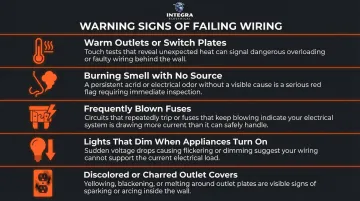
Signs of failing wiring homeowners can look for:
- Warm outlets or switch plates
- Burning smell with no identifiable source
- Frequently blown fuses or tripped breakers
- Lights that dim when an appliance turns on
- Discolored or charred outlet covers
Rewiring doesn't always mean a full-house project. A licensed electrician can assess which circuits are at risk and prioritize accordingly, often completing targeted rewiring alongside other upgrades to save time and cost.
Efficiency & Modern Convenience Upgrades: Upgrades That Pay You Back
These upgrades aren't just about safety — they improve daily life, reduce energy costs, and make your home more attractive to future buyers.
EV Charging Station (Level 2)
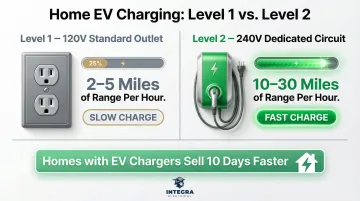
Level 1 charging — using a standard 120V outlet — adds only 2 to 5 miles of range per hour. Level 2 charging, which operates on a 240V dedicated circuit, adds 10 to 30 miles of range per hour, cutting charge times and making electric vehicle ownership practical for daily use.
A dedicated 240V circuit requires a panel with available capacity, making this upgrade dependent on a panel assessment first. In Iowa, EV registrations have grown to 11,700 electric vehicles and 7,300 plug-in hybrids as of 2024, and the trend is accelerating nationwide. Homes with an EV charging station can sell 10 days faster than similar homes, making this upgrade a valuable investment even if you don't currently own an EV.
LED Lighting & Smart Switches
LED lighting isn't just a bulb swap — it's a fundamental efficiency upgrade. Residential LEDs use at least 75% less energy and last up to 25 times longer than incandescent lighting. For the average household, switching to LED bulbs saves $50 to $100 annually compared to traditional incandescent bulbs.
Pairing LED upgrades with dimmer switches or smart lighting controls amplifies the value. Smart switches add scheduling, remote control, and motion sensing — so your exterior lights come on automatically at dusk, your living room dims for movie night, and you can check whether you left lights on from anywhere.
Smart Home Features, USB Outlets & Additional Circuits
Extension cords and power strips are not permanent solutions. CPSC estimates there are 4,600 residential home fires each year associated with extension cords, killing 70 persons and injuring 230 others annually. Overloaded strips create fire hazards that a licensed electrician can eliminate by adding dedicated circuits and USB-integrated outlets in the rooms where demand is highest.
Smart home devices often need more than a standard outlet to work safely. Doing these upgrades together — rather than one at a time — saves money on labor and avoids repeat service visits. A coordinated installation typically covers:
- Dedicated circuits for thermostats, security cameras, and smart locks
- Additional outlets placed where you actually use devices
- USB-integrated outlets that eliminate the need for bulky adapters
- Circuit upgrades sized to handle today's device loads — and tomorrow's
Future-Proofing: Upgrades That Protect When Things Go Wrong
These two upgrades represent the final layer of a comprehensive electrical upgrade plan — focused on continuity and early detection.
Backup Generator Installation
Portable generators require manual setup, extension cords, and constant monitoring. Standby whole-home generators connect directly to your electrical panel and activate automatically during an outage, providing a genuine safety net for households with medical equipment, extreme weather exposure, or work-from-home setups.
Generator installation requires proper transfer switch wiring to prevent backfeed into the utility line — a potentially lethal hazard. CPSC explicitly warns that backfeeding presents an electrocution risk to utility workers and neighbors served by the same transformer. This is not a DIY project.
In Iowa, distribution systems averaged 200.3 minutes of interruption per customer in 2024 — over three hours of downtime annually. For households dependent on electricity for critical functions, a standby generator provides uninterrupted power and peace of mind. In the West North Central region, backup power generator projects recoup 69% of their cost at resale, making it a solid investment.
Smart Smoke & Carbon Monoxide Detectors
Traditional smoke detectors only help if someone is home to hear the alarm. Smart detectors connect to Wi-Fi and send real-time alerts to your smartphone even when you're away, enabling faster emergency response.
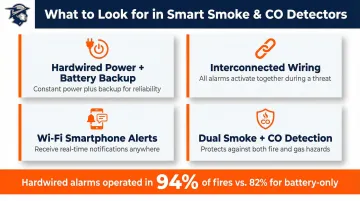
The statistics are sobering: almost three out of five home fire deaths occur in properties with no smoke alarms (41%) or alarms that failed to operate (16%). The power source makes a measurable difference: hardwired alarms operated in 94% of fires large enough to trigger them, compared to 82% for battery-powered units.
When upgrading, look for detectors that combine:
- Hardwired power with battery backup for reliability during outages
- Interconnected wiring so triggering one alarm activates every unit in the home
- Wi-Fi connectivity for smartphone alerts when no one is home
- Dual-sensor or combo units that detect both smoke and carbon monoxide
For Des Moines homeowners — especially in older homes where detectors may be battery-only and installed independently — this upgrade closes one of the most dangerous gaps in home safety.
How to Decide Which Upgrades to Prioritize for Your Home
Start with a simple framework — let your home's current condition, not aesthetics or trends, dictate the sequence:
- Safety first: panel condition, GFCI/AFCI protection, grounding, wiring integrity
- Protection next: whole-home surge protection
- Convenience and future-proofing last: USB outlets, EV charging, smart controls
Many homeowners don't know where their home's electrical system currently stands. A professional safety evaluation is the right starting point before investing in any upgrade. family-owned Integra Electrical offers a complimentary (zero-cost) Safety Evaluation using a Digital Voltage Analyzer to identify overloaded circuits and hidden risks before recommending any work — a transparent, pressure-free way to build a prioritized upgrade plan.
Cost varies by scope and home condition, but combining upgrades in a single visit — say, a panel upgrade alongside GFCI outlets and surge protection — typically reduces total labor costs compared to booking each job separately. One visit also means one disruption to your day instead of three.
Frequently Asked Questions
Frequently Asked Questions
How much does it cost to upgrade your electrical system?
Costs vary widely by scope — from a few hundred dollars for GFCI outlet upgrades to $3,000–$10,000+ for full panel replacements or rewiring. A professional assessment gives you accurate pricing based on what your home actually needs.
What is the average cost to upgrade a residential electrical panel?
A 200-amp panel upgrade typically ranges from $1,200 to $2,000, though factors like amperage increase, permit requirements, and service entrance work affect total cost. Your electrician can walk you through permit requirements and any service entrance work that might add to the total.
Can I upgrade my electrical panel without rewiring my house?
Yes — a panel upgrade and rewiring are separate projects. A panel can be upgraded independently, but if wiring is outdated or damaged, your electrician may recommend addressing both together for safety and cost efficiency.
Is upgrading to 200-amp service worth it?
If your home runs on 100 amps or less and you're adding EV chargers, electric appliances, or smart systems, 200-amp service is worth it. It gives you capacity for current and future demand while reducing the risk of overloads.
Does a house need rewiring after 25 years?
Not automatically, but homes of that age should be inspected — especially if knob-and-tube or aluminum wiring is present, or if you're experiencing signs of electrical stress like frequent breaker trips or dimming lights.
What upgrades bring the most value to a home?
Panel upgrades, GFCI/AFCI protection, and whole-home surge protection deliver the strongest combination of safety and resale value. EV charging stations and smart home wiring have also become significant selling points for today's buyers.