
![How Much Does Knob and Tube Wiring Replacement Cost? [2026]](https://file-host.link/website/integraelectrical-16yffv/assets/blog-images/4ffea801-0d11-4db1-add1-ac0ae1f15b25/1776208545016665_9d9bebcd7c5046b69b1bf999c2017ad2/360.webp)
Introduction
You've just discovered knob and tube wiring in your older Des Moines home. The panic sets in. What will this cost to fix? Can you afford it? Is it even safe to wait?
Knob and tube (K&T) wiring was the standard installation method from the 1880s through the 1940s, using ceramic knobs and tubes to route wires through wall cavities. By today's standards, it's a safety liability.
The system lacks a ground wire, has deteriorating cloth and rubber insulation, and can't handle the amperage demands of modern appliances — including EV chargers and central air conditioning.
Replacement isn't optional for most homeowners. Insurance companies refuse coverage or charge significantly higher premiums for homes with active K&T wiring. Many lenders flag it during mortgage processing, and approximately 46,000 fires involving home electrical distribution systems occur annually, resulting in 440 deaths and $434 million in property losses.
This guide breaks down real cost ranges, what drives those costs up or down, what's often left off quotes, and how to budget smart for this critical safety project.
Key Takeaways
- National average cost for knob and tube wiring replacement ranges from $12,000 to $36,600, with typical pricing falling between $10–$20 per square foot
- Cost drivers include home size, wiring accessibility, labor rates, and whether your electrical panel needs upgrading
- Easy attic/basement access keeps costs lower; plaster walls and tight spaces push them higher
- Additional costs—permits, drywall repair, painting, and cleanup—are almost always part of the project and should be budgeted from day one
- Replacing knob and tube wiring restores insurability, reduces fire risk, and adds measurable resale value
How Much Does Knob and Tube Wiring Replacement Cost?
Knob and tube wiring replacement does not have a fixed price. Costs vary significantly based on home size, construction type, local labor market, and scope of work.
National average cost range: $12,000 to $36,600 for a whole-home rewire, with most projects averaging around $24,300. The typical per-square-foot rate ranges from $10 to $20.
For Des Moines homeowners, local pricing tracks closely with national figures. Des Moines electricians earn a median hourly wage of $31.08, nearly identical to the national median of $29.98 — so the ranges below apply directly to your project.
Cost by Home Size
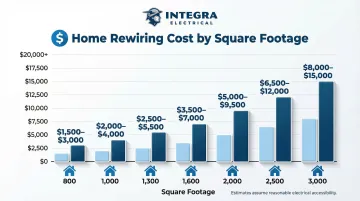
These figures assume reasonable accessibility—homes with limited crawl space, no basement, or plaster walls will see costs increase.
| Square Footage | Average Cost Range |
|---|---|
| 800 sq ft | $8,000 – $16,000 |
| 1,000 sq ft | $10,000 – $20,000 |
| 1,300 sq ft | $13,000 – $26,000 |
| 1,600 sq ft | $16,000 – $32,000 |
| 2,000 sq ft | $20,000 – $40,000 |
| 2,500 sq ft | $25,000 – $50,000 |
| 3,000 sq ft | $30,000 – $60,000 |
Cost by Scope
The scope of work has a major impact on your final quote. Here's how the two common approaches compare:
- Partial replacement (one or two circuits or rooms) costs significantly less upfront, but may not satisfy your insurer — many require complete K&T removal before approving or renewing coverage
- Whole-home rewire eliminates the wiring entirely, resolves insurance requirements, and brings your home up to current code
- Per-opening pricing is common: electricians typically charge a flat rate of $100 to $350 per opening (each outlet, switch, or fixture)
- Code compliance adds cost — modern code requires receptacles every 12 feet, so older homes often need more outlets than existed originally
What Factors Drive Up the Cost of Knob and Tube Wiring Replacement?
Several variables can push the cost well above or below the average. Understanding them helps homeowners set a realistic budget before getting quotes.
Home Size and Number of Circuits
The larger the home and the more circuits involved, the more wire, outlets, switches, and labor hours are required. Home size is the single biggest cost driver — a 3,000-square-foot home requires roughly three times the materials and labor of a 1,000-square-foot bungalow.
Accessibility of Wiring
Homes built between the 1880s and 1940s often feature:
- Plaster walls instead of drywall, complicating wire routing
- Tight attic spaces with limited clearance
- No basement access, forcing electricians to fish wires through finished walls
Each complication increases labor time considerably. Opening walls completely to rewire the electrical system adds 25% to 30% to the total project cost. Homes where electricians must open more walls will also face higher drywall repair costs afterward.
Age and Condition of the Home
Older homes may reveal additional hidden problems once walls are opened:
- Damaged joists compromising structural integrity
- Prior amateur wiring modifications creating fire hazards
- Fire-damaged insulation near deteriorating wiring
- Outdated or improperly sized circuits
These surprises can add unexpected cost, which is why a thorough inspection upfront matters. family-owned Integra Electrical's complimentary (zero-cost) Safety Evaluation using a Digital Voltage Analyzer gives Des Moines homeowners a clear picture of their wiring condition and the full scope of work needed before any commitment is made.
Local Labor Rates
Electricians typically charge between $50 and $100 per hour nationally, with some markets ranging as high as $130 per hour. Des Moines rates align closely with national medians, but getting at least two or three local quotes ensures competitive pricing.
Electrical Panel Compatibility
Knob and tube systems typically run through a 60-amp box. Most modern homes require 100 to 400 amps to support today's appliance loads. Panel upgrades almost always accompany a full rewire (expect this to be part of your project), and each tier carries its own cost range:
| Panel Amperage | Cost Range |
|---|---|
| 100 amps | $800 – $1,500 |
| 150 amps | $1,300 – $1,600 |
| 200 amps | $1,300 – $3,000 |
| 400 amps | $2,000 – $4,000 |
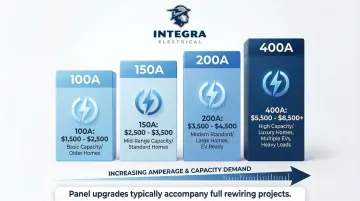
Upgrading to the modern standard of 200 amps adds $1,300 to $3,000 to the total project cost.
Full Cost Breakdown: What's Included — and What's Extra
The quote from an electrician rarely covers everything. Here's what the total project cost actually includes, broken into must-have line items and common add-ons.
Core Project Costs (Usually in the Base Quote)
- Labor — The largest line item. Electricians bill $50–$100/hr to disconnect the old system, route new wiring, and connect outlets, switches, and fixtures to code.
- Materials — New NM (non-metallic sheathed) cable, electrical boxes, wire connectors, and basic outlets/switches. Materials run $0.25–$2.00 per linear foot; 14/2 Romex is approximately $0.46/ft and 12/2 Romex about $0.66/ft.
- Permits and inspections — Most jurisdictions require permits. Permit costs average $100–$125, though Des Moines base electrical permit fees start at $51.50 plus unit fees. Pre- and post-inspections typically add $100–$150 each.
Common Add-On Costs (Often Not in the Base Quote)
- Drywall or plaster repair — Walls are almost always opened during rewiring. Drywall repair runs $50–$150/sq ft ($60–$900 total). Lath-and-plaster repairs, common in older Des Moines homes, cost $80–$200/sq ft — roughly 2–4x more than standard drywall.
- Outlet, switch, and fixture upgrades — Current code requires GFCI outlets in kitchens, bathrooms, and laundry rooms at $130–$300 per outlet. The NEC also requires receptacle outlets every 12 feet in living spaces, which may mean adding new openings at $100–$350 each.
- Cleanup and disposal — Debris removal and hauling typically adds $300–$500. Interior painting to restore walls post-repair averages around $1,960 for a full interior. Budget both separately.
Is It Worth Replacing Knob and Tube Wiring?
For most homeowners, this isn't really a question of "if" but "when." Here's why replacement is almost always worth the investment.
Safety, Insurance, and Financing Implications
Knob and tube wiring carries serious fire and shock risks:
- No ground wire, meaning it cannot safely service three-pronged appliances or provide surge protection
- Deteriorating insulation that dries out, crumbles, and exposes live wires
- Inability to support modern electrical loads, leading to overloading and unsafe modifications
Many homeowners insurance companies refuse to cover homes with active knob and tube wiring, or charge significantly higher premiums. FHA and VA loan appraisers flag K&T wiring as a safety concern, and underwriting guidelines generally require remediation before the loan can close. Updated wiring also helps homes sell faster, pass inspections more easily, and attract more buyers.
Long-Term Value
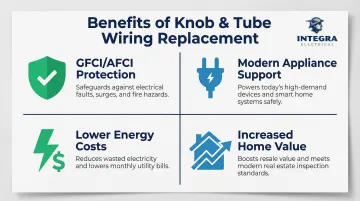
Replacing knob and tube wiring delivers several long-term benefits:
- Modern safety devices (GFCI and AFCI protection) that prevent electrical fires and shocks
- Support for today's appliance loads without risk of overheating or tripped breakers
- Lower monthly energy costs by reducing inefficiencies in the old system
- Increased home value and marketability
For Des Moines homeowners unsure where their system stands, Integra Electrical's complimentary Safety Evaluation identifies the true scope of work before any commitment is made.
How to Save Money on Knob and Tube Wiring Replacement
While there's no safe way to cut corners on the electrical work itself, there are smart ways to reduce the total project cost without compromising quality.
Here's where the savings typically come from:
- Get two to three written quotes — prices can differ by hundreds of dollars between contractors, and a detailed quote lets you compare scope, not just price
- Patch drywall and repaint yourself — these post-project tasks are the easiest places to save on labor without touching any electrical work
- Stick with standard outlets and fixtures during the rewire — you can always upgrade later; basic functional options keep materials costs down
- Ask about phased replacement if a full rewire isn't financially feasible right now — prioritize high-risk areas like the kitchen and bathrooms first, though note that partial work may still trigger insurance requirements
Getting multiple quotes before committing is the single highest-leverage step — it costs nothing and often reveals a $1,000+ spread between contractors for the same scope of work.
Frequently Asked Questions
What is the average cost to replace knob and tube wiring?
The national average cost ranges from $12,000 to $36,600, with most projects averaging around $24,300. The per-square-foot rate typically falls between $10 and $20. Local labor rates and accessibility factors will influence the final number.
How long does it take to replace knob and tube wiring?
A full whole-home rewire typically takes 1 to 3 weeks depending on home size, accessibility, and crew size. Smaller or partial jobs may be completed faster, while homes with plaster walls or limited access may take longer.
Is it worth replacing knob and tube wiring?
Yes. Replacement is almost always worth it due to fire and shock risks, insurance complications, inability to support modern electrical loads, and improved home salability.
Can you sell a house with knob and tube wiring?
It's possible to sell, but many buyers' lenders and insurance companies will flag it, often making replacement a condition of sale or significantly reducing the pool of willing buyers. Homes with K&T wiring may see property values drop 10% to 15%.
Does homeowners insurance cover knob and tube wiring?
Many insurers will refuse coverage or charge significantly higher premiums for homes with active knob and tube wiring. Some may provide coverage if the homeowner commits to replacing it within a set timeframe (often 60 days).
Can a house be rewired without removing drywall?
In some cases electricians can access wiring through attic, basement, or crawl space without opening walls. However, older homes often require at least some wall cuts. The extent depends on the home's construction and the electrician's access strategy.