
Recessed lighting has become the go-to upgrade for modern homes, chosen by 73% of homeowners renovating their kitchens—outpacing even under-cabinet lighting. But costs swing wildly depending on your home's age, ceiling type, and wiring. A quick retrofit in a new-build basement might cost $600, while adding lights to a 1950s home with plaster ceilings and knob-and-tube wiring could top $3,000 for the same number of fixtures.
This guide breaks down what you'll actually pay, why the numbers vary so much, and what separates a $125-per-light job from a $500-per-light surprise.
Key Takeaways
- Typical range: $125–$300 per fixture installed (labor + materials), with most 4–6 light projects costing $800–$2,500 total
- Cost drivers: Ceiling access, home age, fixture type, and whether you need new wiring or circuits
- Who pays more: Finished ceilings without attic access, older homes with outdated wiring, high ceilings, and smart/dimmable upgrades
- Key takeaway: Labor accounts for 50–70% of total cost, so budgeting by fixture price alone will leave you short
How Much Does Recessed Lighting Installation Cost?
There's no one-size-fits-all price tag for recessed lighting. Costs depend on how many fixtures you install, how hard it is to access your ceiling, and what shape your home's electrical system is in. Misunderstanding these variables leads homeowners to underbudget, choose the wrong fixture type, or get blindsided when the electrician mentions a $1,200 circuit upgrade.
Typical Cost Range
Budget / Minimal Scope ($300–$900 total)
2–4 lights in a simple retrofit with accessible attic space and modern wiring. You're looking at $100–$300 per fixture installed. Perfect for a small bathroom or hallway where the electrician can drop in from above.
Mid-Range / Standard Project ($700–$1,400 total)
4–6 lights in a bedroom or kitchen, standard retrofit or canless LED fixtures. Expect $200–$500 per fixture. This covers the typical Des Moines project: ambient lighting added to a living space with a finished ceiling and serviceable existing wiring.
High-End / Complex Project ($2,000–$4,000+ total)
8+ lights, whole-home installations, older homes requiring new wiring, or smart color-changing fixtures. Costs climb to $300–$500+ per fixture when you're fishing wires through plaster, upgrading panels, or installing premium Philips Hue-style controls.
What's typically included:
- Fixture materials
- Electrician labor (cutting, wiring, testing)
- Basic trim and LED bulbs (if using traditional housings)
What's usually extra:
- Permits ($50–$200 in most Iowa cities)
- Drywall patching and painting ($100–$300)
- Panel upgrades ($500–$1,000+)
- Dimmer switches ($80–$200 per circuit)
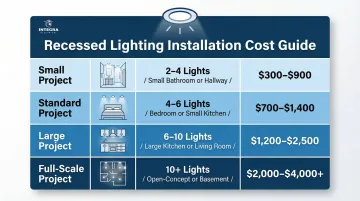
Cost by Number of Lights
| Project Size | Room Type | Total Cost Range |
|---|---|---|
| 2–4 lights | Small bathroom, hallway | $300–$900 |
| 4–6 lights | Bedroom, small kitchen | $700–$1,400 |
| 6–10 lights | Large kitchen, living room | $1,200–$2,500 |
| 10+ lights | Open-concept, basement | $2,000–$4,000+ |
For Des Moines specifically, a typical 8-light installation runs $1,080–$3,240, averaging around $1,800. Those totals break down differently depending on what your electrician charges per fixture—which is where the real sticker shock tends to hit.
Cost Per Fixture: Materials vs. Labor
Here's the part that surprises most homeowners: labor represents 50–70% of the total bill. The fixture is often the cheapest part.
Electrician Labor:
- Hourly rates: $50–$130/hour nationally
- Per-fixture rates: $60–$150 depending on complexity
- Des Moines Metro rates: Moderate compared to coastal cities—BLS data shows mean electrician wages around $31.87/hour (base wage before contractor markup)
Fixture Materials:
- Basic retrofit LED kits: $5–$40
- Canless ultra-thin LEDs: $15–$30
- New construction housings: $7–$100
- Smart/premium fixtures: $60+ (e.g., Philips Hue color-changing)
A $20 fixture can easily run $150 installed once you account for the electrician's time cutting the hole, running wire, and testing the circuit.
Key Factors That Affect the Cost of Recessed Lighting
Understanding what drives price separates a $600 job from a $3,000 job in the same size room. These variables matter more than the number of lights.
Fixture Type and Features
Your options:
- Basic new construction cans: Cheapest when installed before drywall goes up
- Retrofit kits: Snap into existing ceilings; require cutting precise holes and fishing wires
- Canless LED fixtures: Ultra-thin panels that mount directly to drywall, with faster installation and fewer parts
- Smart/dimmable fixtures: Wi-Fi-enabled, color-changing (Philips Hue, etc.); higher material cost and longer setup time
LED fixtures cost more upfront ($15–$60 vs. $5–$15 for basic housings) but eliminate bulb replacements for 15–25 years and use 75% less energy than incandescent.
Ceiling Access and Installation Complexity
This is the single biggest labor variable.
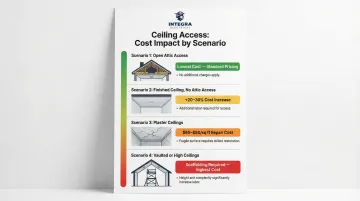
- Open attic access: Fastest and cheapest. The electrician works from above, drops wires, and cuts holes from below with minimal guesswork.
- Finished ceiling, no attic access: 20–30% more expensive, adding $41–$162 per fixture. Wires get fished blindly through closed cavities, often requiring access holes in closets or adjacent rooms.
- Plaster ceilings (common in older Des Moines homes): Plaster cracks easily. Repairs run $65–$80 per square foot vs. $45–$55 for drywall.
- Vaulted or high ceilings: Require scaffolding or lifts, adding equipment rental fees and extended labor time.
Home Age and Existing Wiring
Homes 30+ years old often hide problems that blow budgets.
Common hazards in older homes:
- Knob-and-tube wiring (pre-1950s): Lacks a ground wire, can't be covered by insulation. Full replacement costs $12,000–$36,600.
- Aluminum wiring (1965–1972): Fire hazard at connection points. Repair costs $395–$476 per circuit.
- Undersized panels: 60A or 100A panels can't handle modern loads. Upgrading to 200A costs $1,800–$4,500.
Adding recessed lighting to an overloaded or outdated system violates code and poses fire risks.
Number of Fixtures and Circuit Capacity
More lights lower the per-unit labor cost (your electrician is already on-site with tools out). But there's a limit: overloading a circuit is both dangerous and illegal.
A standard 15-amp household circuit handles about 1,440 watts. Six 10-watt LED recessed lights draw only 60 watts total — plenty of headroom on their own. Add those to a circuit already powering outlets, ceiling fans, and other lights, and you risk tripping the breaker or worse.
If your existing circuits are maxed out, the electrician will run a new line from your panel. That adds $570–$1,000 to the project.
Location-Specific Factors
Where you're installing lights affects both fixture requirements and labor complexity:
- Kitchens and bathrooms: Require moisture-rated fixtures (damp or wet location UL listings) to prevent corrosion and shorts.
- Basements: Insulated ceilings require IC-rated (Insulation Contact) fixtures. Non-IC fixtures need 3 inches of clearance from insulation to avoid fire hazards. Finished basements with limited ceiling access cost more than open, unfinished ones.
- Des Moines Metro labor rates: Moderate compared to coastal cities. National averages run $50–$130/hour; local rates typically fall in the $50–$85/hour range, below most national estimates.
New Construction vs. Retrofit vs. Canless LED: How Installation Type Changes Your Price
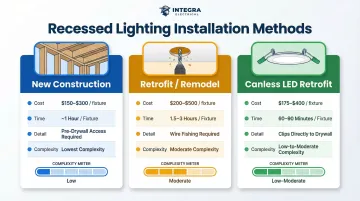
The installation method—not just the fixture—shapes your total cost more than any other factor. There are three main approaches — each with a different labor profile and price range.
New Construction Installation
New construction installs happen before drywall goes up, giving electricians direct access to joists and wiring pathways. No wire fishing, no patching — that's why it's the cheapest option at $150–$300 per fixture installed.
This is worth knowing for price context, but most Des Moines homeowners are working with finished ceilings, which means retrofit is the more relevant scenario.
Retrofit / Remodel Installation
Retrofit is the most common situation: existing finished ceilings, closed wall cavities, and no open access above. The electrician cuts precise holes in drywall or plaster, fishes wires through closed cavities, and patches afterward.
- Typical cost: $200–$500 per fixture installed
- Time per fixture: 1.5–3 hours
- Cost saver: Attic access above the work area can reduce labor costs by $50–$100 per fixture compared to fully closed ceilings
Canless LED Retrofit
Canless LED fixtures are ultra-thin units that clip directly to drywall — no bulky housing can needed. They fit under joists and eliminate the mounting step required for traditional cans.
- Typical cost: $175–$400 per fixture installed
- Time per fixture: 60–90 minutes
- Tradeoff: Style options are limited (mostly white or brushed nickel), but energy efficiency and installation speed are both strong advantages
DIY vs. Hiring a Licensed Electrician—What's the Real Cost Difference?
DIY can save you 50–70% on labor, but the real calculation is more complex than it looks.
DIY Cost Considerations
What you'll spend:
- Fixtures: $5–$60 each
- Wiring and junction boxes: $20–$50
- Tools (hole saw, voltage tester, wire strippers): $50–$150
- Total for a small 4-light project: $250–$800 materials only
What many DIYers forget:
- Permits are still required in Iowa, even for homeowner-performed work on your primary residence. Des Moines charges $78.65 for 1–4 altered circuits.
- Unpermitted work must be disclosed during home sales in Iowa and can void insurance claims if a fire occurs.
- If you don't know how to assess circuit loads or identify outdated wiring in an older home, you could create a genuinely dangerous situation.
Professional Installation Benefits
What you're paying for beyond labor:
- Code compliance and permit handling
- Proper circuit load assessment
- Workmanship warranty
- Ability to catch hidden problems (overloaded circuits, unsafe wiring, undersized panels) before they become emergencies
For Des Moines homeowners with older homes, a licensed electrician's assessment can catch overloaded circuits or outdated wiring before they turn into emergencies. family-owned Integra Electrical includes a complimentary (zero-cost) Safety Evaluation using a Digital Voltage Analyzer before any work begins, so you have a clear picture of your home's electrical condition going in.
When Each Option Makes Sense
DIY is appropriate for:
- Straightforward fixture swaps in accessible ceilings
- Homes with modern wiring and adequate circuit capacity
- Homeowners with solid electrical knowledge and proper tools
Hire a professional for:
- Retrofit projects in finished ceilings
- Older homes (30+ years)
- Any situation requiring new wiring or dedicated circuits
- When permits and inspections are mandatory
What Most Homeowners Get Wrong When Budgeting for Recessed Lighting
Focusing Only on Fixture Cost
The fixture is often the smallest part of the bill. Labor—cutting holes, running wires, testing circuits—typically represents 50–70% of total cost. Budget based on installed price, not Home Depot shelf price.
Forgetting "Add-On" Costs That Are Rarely Optional
These peripheral expenses add hundreds to your project:
- Permits: $50–$200 in most Iowa jurisdictions
- Dimmer switches: $80–$200 per circuit
- Drywall patching and repainting: $60–$900 (electricians don't usually patch; you'll hire a separate contractor)
- Panel or circuit upgrades: $500–$1,000+ if your electrical system is undersized
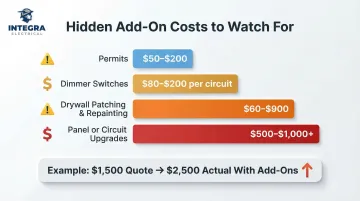
A $1,500 quote can easily hit $2,500 once these are factored in.
Choosing the Cheapest Quote Without Evaluating What's Included
The lowest bid often excludes permits, uses lower-grade fixtures, or doesn't account for complications in older homes. To make quotes comparable, ask each contractor to itemize:
- Labor costs
- Fixture materials and specifications
- Permit fees
- Any anticipated wiring work or circuit additions
- Drywall repair (if included)
With that detail in hand, you can evaluate quotes side by side—not just by the bottom line.
Conclusion
The cost to install recessed lighting varies widely—from $300 for a small bathroom retrofit to $4,000 for a whole-home upgrade in an older house. The drivers are fixture type, ceiling access, home age, and local labor rates. Knowing which factors apply to your home is what turns a rough estimate into a reliable budget.
That assessment starts with your specific home—its wiring, ceiling construction, and existing circuits. For Des Moines Metro homeowners, the most reliable first step is a quote from a licensed local electrician who walks through those conditions before naming a number. Integra Electrical has served the Des Moines area since 2003, earning a 4.9-star rating across 1,000+ Google reviews. Every job starts with a complimentary Safety Evaluation so homeowners know exactly what they're getting into before any work begins.
Frequently Asked Questions
How much does it cost to install recessed lighting?
Typical installed cost ranges from $125–$300 per fixture, with most 4–6 light projects totaling $800–$2,500. The final number depends on fixture type (basic LED vs. smart), ceiling access (open attic vs. finished ceiling), and your home's existing wiring condition.
How much does it cost to install 4 recessed lights?
A 4-light project typically costs $300–$900 for budget installations with accessible ceilings and modern wiring. Mid-range scenarios with finished ceilings or standard retrofits run $700–$1,400. Cost varies most based on ceiling type, home age, and whether you're adding dimmers or smart controls.
How much does an electrician charge to install recessed lighting?
Electricians charge $50–$130 per hour nationally, or $60–$150 per fixture depending on complexity. Des Moines Metro rates fall toward the moderate end of that range, reflecting local labor costs for licensed, experienced electricians.
How much does it cost to install recessed lighting in a basement?
Basement installations often fall in the mid-to-upper cost range ($1,200–$2,500 for 6–10 lights) due to limited ceiling access, moisture-rating requirements, and the frequent need to run new wiring. Finished basements are significantly more complex than unfinished ones.
Can a handyman install recessed lights?
While a handyman may swap existing fixtures, new recessed lighting installation requires a licensed electrician in Iowa due to wiring, permitting, and code requirements. Unlicensed electrical work can void homeowner's insurance and must be disclosed during home sales.
How many recessed lights do I need in a 12x12 room?
A 12×12 room typically needs 4–6 recessed lights for even ambient coverage. Space them roughly half the ceiling height apart—about 4 feet for 8-foot ceilings—and keep them 2–3 feet from walls to avoid harsh shadows.