
How to Know if Your Electrical Panel Is Big Enough for Your Home
December 6th, 2025
3 min read
If you have ever turned on your microwave and the kitchen lights blinked like they were trying to send Morse code, you are not alone. A lot of homeowners notice things like flickering lights or tripping breakers and think, “Okay, something feels off here,” but there is no handbook that explains what any of it means. You are just trying to make toast without the house getting dramatic about it.
At Integra Electrical, we help homeowners make sense of this every day. There is no reason you should already know how your electrical panel works. Most people only think about it when something gets loud, blinks, or feels warm. Our job is to make this simple so you feel confident, not confused.
Before the end of this article, you will know:
- What Your Electrical Panel Actually Does
- Signs Your Panel Might Be Too Small
- How to Check Your Panel Size
- When an Upgrade Makes Sense
What Your Electrical Panel Actually Does
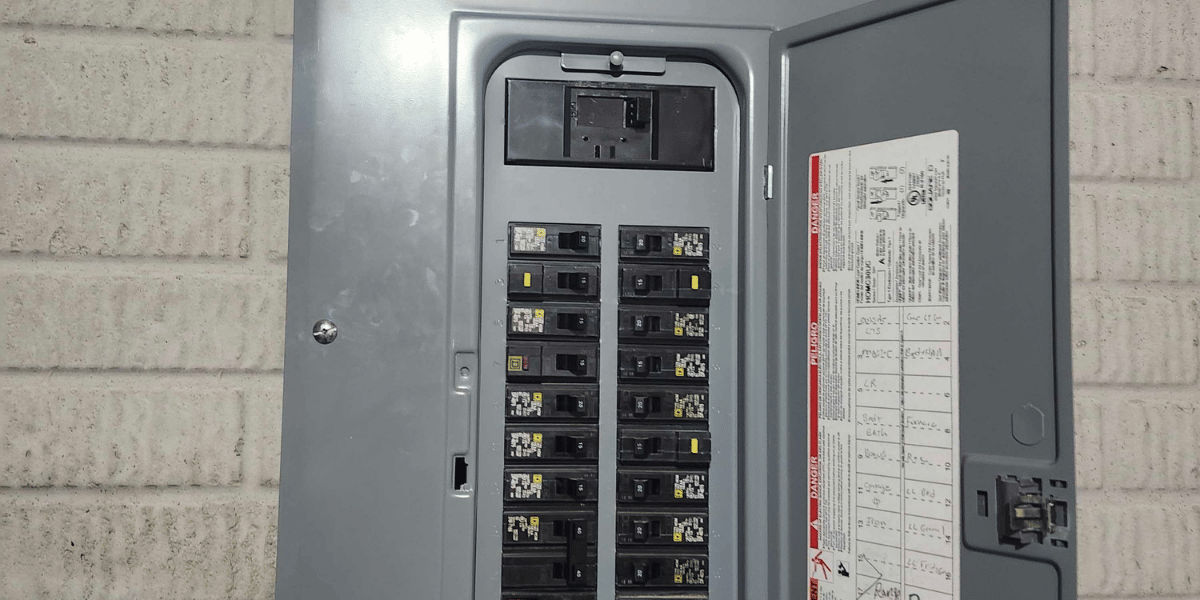
Your electrical panel is the distribution center for all the power in your home. Electricity comes in from the utility company, goes through your panel, and then the panel sends power to different circuits. Each circuit feeds a section of your home or a group of devices, like your kitchen outlets, your bedroom lights, or your air conditioner.
Another way to picture it: your panel is like a water main with branches of pipes that feed different rooms. If only one faucet is turned on, no problem. If twelve faucets, a sprinkler, a shower, and a washing machine all try to run at once, water pressure drops. The same thing happens with electricity. When too much tries to flow through one branch, your breaker says, “Okay, that’s enough,” and shuts the circuit off to prevent overheating.
Most of the time, this balance happens quietly and smoothly, and you never notice it. But if your home now uses more power than the panel was designed to handle, the system starts signaling that it is working too hard.
Signs Your Panel Might Be Too Small
Breakers that trip often: If you are flipping the same breaker regularly, the panel is likely straining to provide enough power.
Lights flickering or dimming: If your lights dip when a big appliance turns on, the circuits are competing for power.
The panel feels warm: The outside of the panel should not feel warm to the touch. Warmth is the panel working harder than it should.
Lots of power strips and extension cords: Modern life uses more devices than older homes were designed for. If you keep running out of outlets, your electrical system may be undersized.
You have to “schedule” appliance use: If you have ever said, “No one run anything, I’m using the microwave,” that is your panel throwing up a tiny white flag.
These signs do not mean anything dangerous is happening. They simply mean your home may be using more electricity than the panel was built to support.
How to Check Your Panel Size
This part is easy. No tools required.
- Find your electrical panel.
- Open the door.
- Look for a number printed near the main breaker: 60, 100, 125, 150, or 200 amps.
Here is what those numbers mean in everyday life:
60 amps
Common in older homes. Built for basic needs like lights and maybe one or two small appliances. Not designed for modern living.
100 amps
Works in smaller homes, but can feel limited if multiple large appliances run at the same time.
150 amps
A middle option. Works for many homes, but can get stretched with home offices, workshops, and extra freezers.
200 amps
The modern standard. Enough breathing room for kitchen appliances, AC, devices, and add-ons like hot tubs or EV chargers.
A quick note on safety
Do not remove the panel cover. The inside contains live electrical components. Just read the label on the front. If the label is old or scraped off, we can identify the panel size for you during a quick evaluation. No pressure. No guessing. No sparks. Everyone stays happy.
When an Upgrade Makes Sense
Upgrading is not about being fancy. It is about giving your home enough room to operate comfortably.
You might consider upgrading your panel if you are adding:
- A hot tub
- A finished basement
- A home office with multiple devices
- A second fridge or freezer
- An EV charger
- A workshop with power tools
You may also want to upgrade if your panel is 40+ years old or one of the recalled brands. We can check that quickly for you and show exactly what it means.
When your panel has enough capacity, everything in your home just works. No flickering. No strategizing appliance use. No wondering why the breaker flipped again. Just normal, smooth, everyday life.
Next Steps
If you are unsure whether your panel is big enough, a simple evaluation can answer that. We take a look, explain what you currently have, how your home uses power, and whether everything is operating comfortably.
There is no pressure. Sometimes the fix is small. Sometimes an upgrade makes life easier. Either way, the goal is clarity so you can make decisions confidently.
If you would like us to take a look, we would be happy to help whenever you are ready.
FAQs
Can I just replace a few breakers instead of upgrading the panel?
Replacing breakers does not increase the total power available. It is like reorganizing a closet without adding space.
How long does a panel upgrade take?
Most upgrades are completed in one day, with power off for only part of that time.
Do I need a permit?
Yes. We handle the permit and inspection for you.
Does upgrading increase home value?
Often, yes. A modern electrical system is a selling point and makes daily life more comfortable.
Daniel Carpenter is a licensed electrician on Integra’s installation team. He got his license at just 19, but he's been around the trade his whole life. With five years on the job and a heart for helping homeowners, Daniel takes pride in doing quality work that serves the local community.
